Power and Lighting for Art Fair Booths: Technical Setup Guide
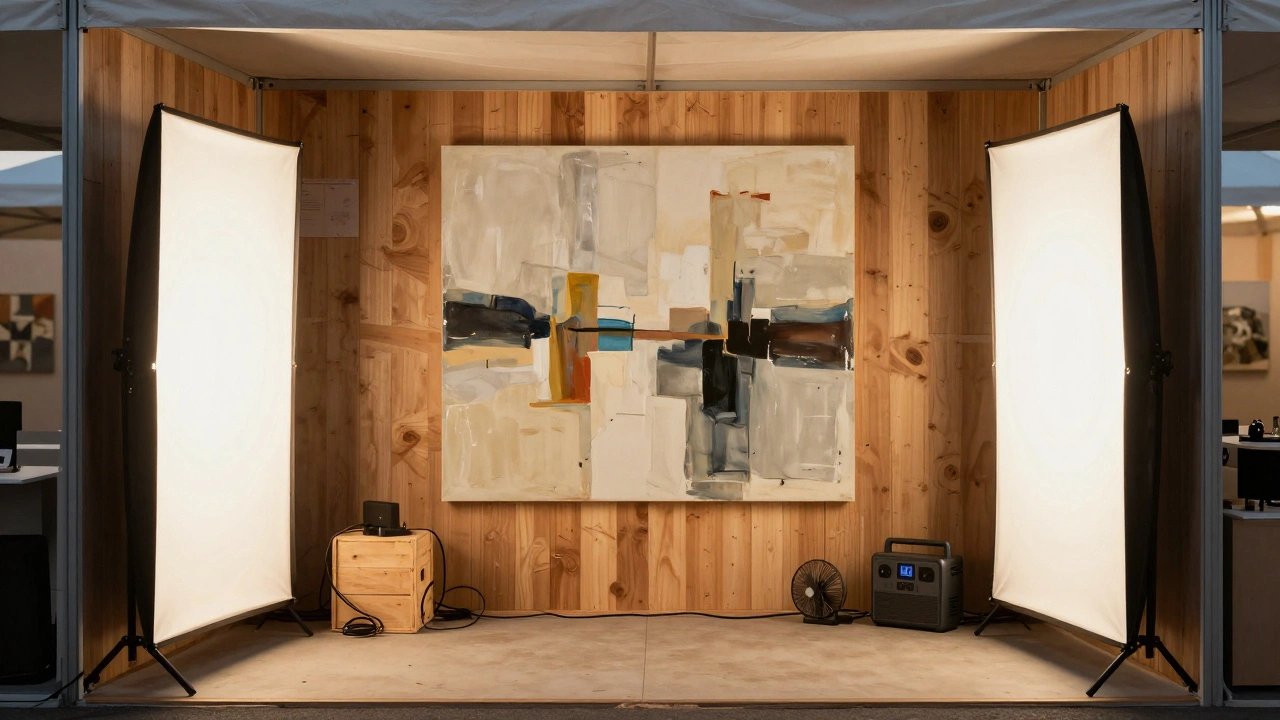
Setting up an art fair booth isn’t just about hanging paintings or arranging sculptures. The real magic happens when the lights hit the right spot, the power stays stable, and nothing flickers during peak hours. Too many artists lose sales because their work looks dull under poor lighting, or worse-because a circuit breaker trips and the whole booth goes dark. This isn’t about fancy gear. It’s about knowing exactly what you need, how to set it up, and how to avoid the most common mistakes that ruin a day at the fair.
What Power Do You Really Need?
Most art fairs provide a single 15-amp, 120-volt outlet per booth. That’s it. No more. No exceptions. But what can you actually run on that? A typical LED art light draws 10 to 15 watts. A small fan for airflow? 40 watts. A tablet for digital catalog sales? 10 watts. Add up a few lights, a small speaker for ambient music, and a credit card reader, and you’re already at 150-200 watts. That’s fine-most of these devices use far less than the 1,800-watt limit of a 15-amp circuit. The problem isn’t total power. It’s what happens when something else on the same circuit draws too much.
Many booths share circuits with neighboring vendors. If someone plugs in a space heater, a coffee maker, or a high-wattage sound system, your lights might dim or shut off. That’s why you need a power strip with surge protection and a built-in circuit breaker. Look for one rated for at least 1,500 watts. Brands like Tripp Lite and Belkin make reliable ones that fit in a small tote. Don’t rely on the cheap $10 strips from big-box stores. They’re not built for constant use, and they’re a fire risk when pushed.
Lighting: It’s Not Just About Brightness
Lighting is what turns a good piece of art into a showstopper. But not all lighting is created equal. You don’t need studio-grade spotlights. You need consistent, color-accurate light that doesn’t wash out pigments or create harsh shadows.
LED panels with a color temperature of 5000K are the industry standard for galleries and art fairs. That’s daylight white-neutral, crisp, and true to how the artwork looks in natural light. Avoid warm white (2700K-3000K). It makes blues look muddy and reds look overly orange. Avoid cool white (6500K+). It gives everything a clinical, blue tint that drains warmth from paintings.
Use at least two light sources per booth. One on each side of the main piece, angled at 30 to 45 degrees. This eliminates glare and flattens shadows. If you’re displaying three-dimensional work-sculptures, ceramics, mixed media-add a third light from above, slightly behind the piece. This creates depth without casting dark areas on the front.
Portable LED panels like the Aputure Amaran COB 60d or the Godox LEDP 60D are lightweight, battery-ready, and plug into standard outlets. They’re also dimmable. That’s critical. You can’t control ambient light outdoors, but you can control your booth’s output. Test your setup before the fair. Stand in the exact spot where visitors will pause. Look at your work from three feet away. Does it glow? Or does it look flat and lifeless?
Battery Backup: The Silent Sales Killer
Power outages at art fairs aren’t rare. They happen during thunderstorms, during electrical overloads, or because a vendor accidentally overloaded a shared line. If your lights go out, your art goes unnoticed. If your tablet dies, you can’t take payments. If your speaker stops, the atmosphere vanishes.
That’s why every serious booth needs a small power station. Look for a 500-1000Wh lithium-ion unit with AC outlets, USB ports, and a pure sine wave inverter. Models like the Jackery Explorer 500 or the Anker PowerHouse 500 can run two LED lights and a tablet for 6-8 hours. They’re quiet, portable, and recharge via solar panels or a car outlet. Many fairs let you bring your own generator, but most prohibit gas-powered units because of fumes and noise. Stick with lithium.
Charge your power station the night before. Test it. Plug in your gear. Let it run for an hour. If the battery drops more than 10% in that time, you’re overloading it. Swap out a light for a lower-watt model. Reduce your speaker volume. Every watt counts.
Wiring and Safety: Don’t Risk It
Art fair floors are crowded, uneven, and often wet. A loose cord underfoot can trip a visitor-and that’s a lawsuit waiting to happen. Never run cables across walkways. Use rubber cord covers or tape them flat to the floor with gaffer tape. Never use duct tape. It leaves residue and peels up under pressure.
Keep all power strips and adapters off the ground. Elevate them on a small wooden crate or a plastic storage bin. Moisture from the floor can corrode connections. Water + electricity = danger. If you’re outside, make sure your power station and strips are under a canopy or tent with a waterproof cover. Even a light drizzle can ruin a cheap power adapter.
Label everything. Use colored tape or tags to mark which device plugs into which outlet. That way, if you need to reset a breaker, you know what to unplug first. And always have a spare power strip, a few extra extension cords, and a roll of gaffer tape in your kit. These aren’t luxuries. They’re essentials.
Testing Before You Arrive
Don’t wait until you’re at the fair to find out your lights don’t work. Set up your entire booth at home. Plug in every device. Turn everything on. Let it run for two hours. Walk around. Look at your art from every angle. Does the lighting highlight texture? Does it make the colors pop? Are there any flickers? Do any cords feel warm to the touch? If so, you’re overloading the circuit.
Take a photo of your setup. Use it as a checklist when you arrive. Know exactly where each cord goes. Know which outlet powers what. If the fair assigns you booth #27, call ahead. Ask if the outlet is on the left or right wall. Is it near the ceiling or floor? Knowing this saves you 45 minutes of fumbling on setup day.
What to Avoid
- Incandescent bulbs-they run hot, waste power, and fade colors over time.
- Unshielded extension cords-they’re a tripping hazard and prone to fraying.
- Plugging into extension cords that plug into other extension cords-that’s called a daisy chain, and it’s a fire risk.
- Using dimmer switches not rated for LEDs-they can cause buzzing or flickering.
- Leaving batteries unattended overnight-they can overheat if left charging in a hot car or tent.
Pro Tips from the Field
- Use a small fan to keep your electronics cool. Electronics in enclosed booths can overheat, especially in direct sun.
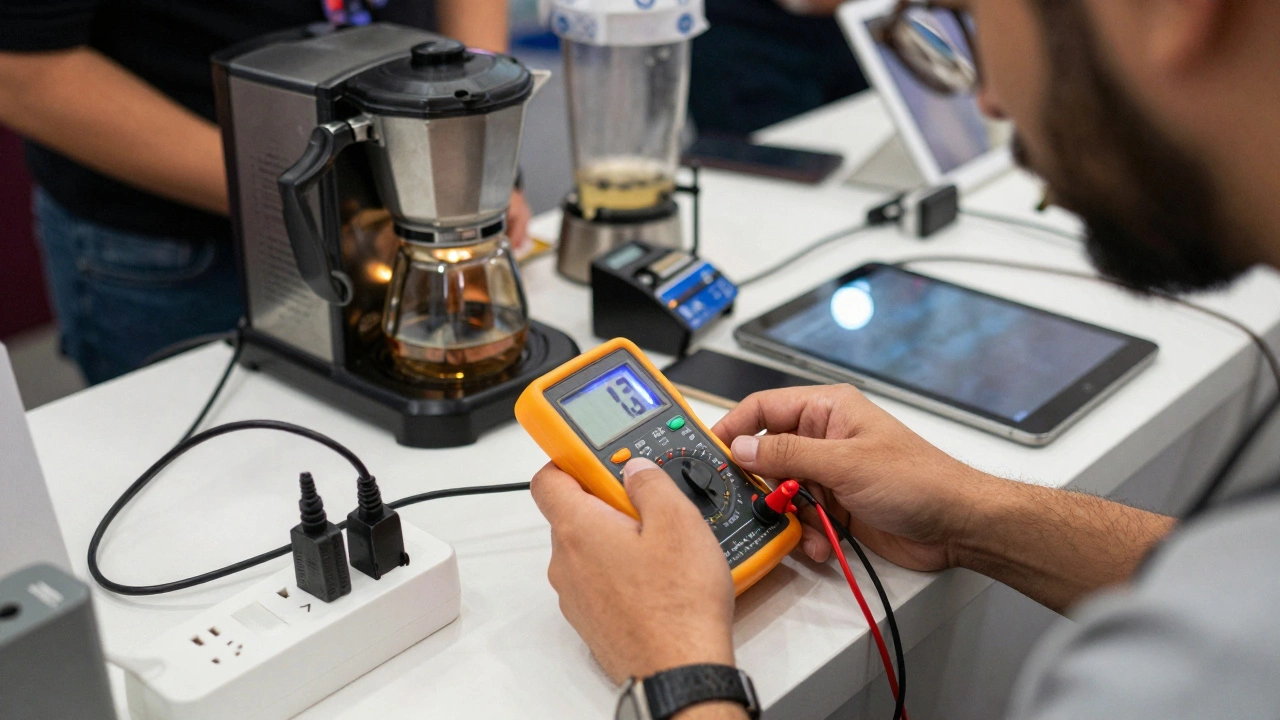
- Bring a digital multimeter. It costs $20. It can tell you if your outlet is delivering full voltage. If it’s below 110V, you’re at risk.
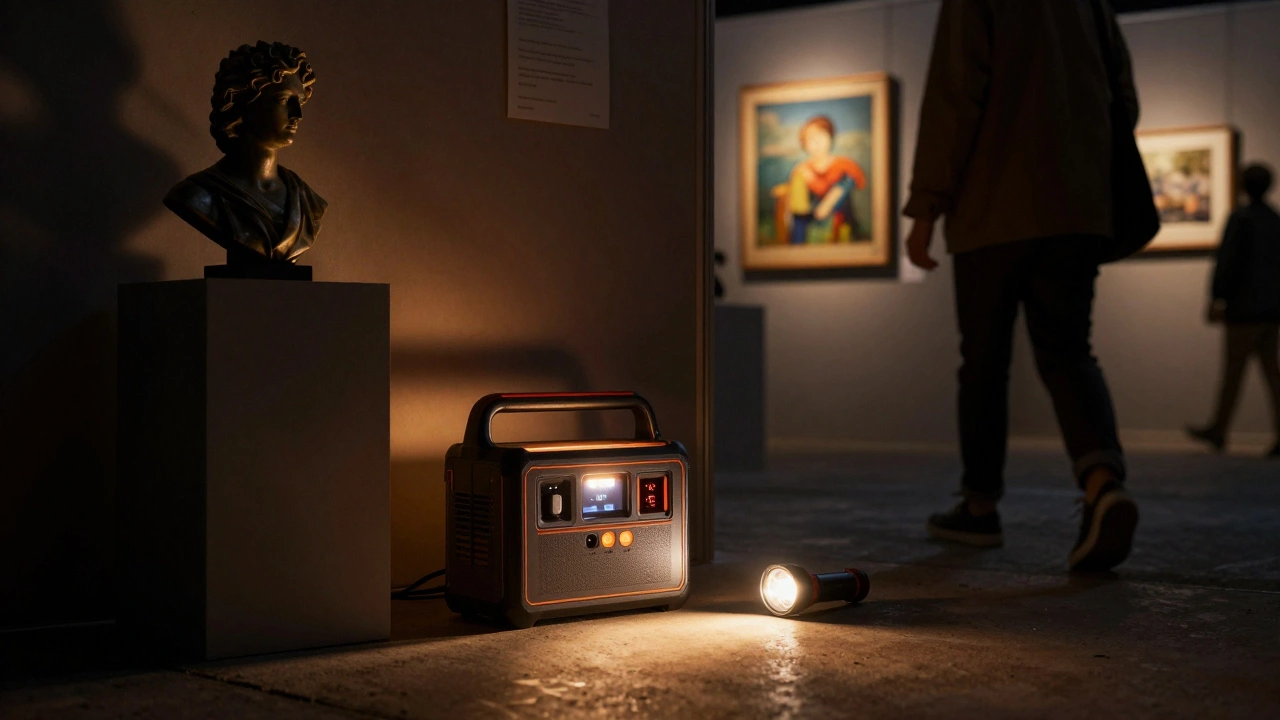
- Keep a flashlight in your kit. If the power goes out, you’ll still need to see your work-and your customer.
- Ask the fair organizer for a list of approved vendors. Some fairs require you to use their rental lighting or power systems. Don’t assume you can bring your own.
- Record a 15-second video of your booth in action. Play it back. Would you stop and look? If not, adjust the lighting.
Final Checklist
- LED lights (two or more, 5000K color temp)
- Surge-protected power strip with circuit breaker
- Lithium power station (500Wh minimum)
- Extension cords (short, heavy-duty, 14-gauge)
- Gaffer tape and cord covers
- Spares: bulbs, fuses, chargers
- Small fan for ventilation
- Digital multimeter (optional but recommended)
- Flashlight
- Booth map or photo of your setup
Art fairs are about connection. Your work deserves to be seen the way you intended. The right lighting doesn’t just make your art look better-it makes people stop, stare, and remember. Don’t let a faulty cord or a dim bulb cost you a sale. Be ready. Be confident. And let your art speak-loud and clear.
Can I use regular household lights for my art booth?
No. Regular household bulbs-especially incandescent or warm LED bulbs-don’t show color accurately. They can make blues look gray and reds look muddy. Stick with LED panels rated at 5000K color temperature. That’s the standard used by museums and galleries because it matches daylight and shows true color.
How many watts do I need for a typical art booth?
Most booths use between 150 and 300 watts total. Two LED panels (15W each), a tablet (10W), a small speaker (20W), and a credit card reader (5W) add up to about 75W. But you need headroom. A 15-amp circuit can handle up to 1,800 watts, but shared circuits mean you should stay under 500W to avoid tripping breakers. Always use a surge protector with a built-in breaker.
Do I need a generator for my booth?
No. Gas generators are loud, smelly, and often banned at art fairs. Instead, use a portable lithium power station (500-1000Wh). They’re quiet, clean, and rechargeable. Many fairs allow them, and they’re far more practical for running lights and small electronics.
Can I plug my power station into the fair’s outlet?
Yes, but only if the outlet is on a dedicated circuit. Many fairs limit each booth to one outlet. If you plug a power station into it, you’re still using that one outlet. Make sure your power station can recharge from a standard 120V outlet before you assume it’s a backup solution.
What should I do if my lights flicker at the fair?
Flickering means your circuit is overloaded or your power source is unstable. Unplug one device at a time until the flickering stops. If it’s the power station, it may be low on charge or faulty. If it’s the outlet, the circuit is shared and overloaded. Ask the fair staff if you can move to another booth with a different circuit. Always test your setup at home before you go.