Minimalism in Contemporary Art: Essential Forms and Reduction
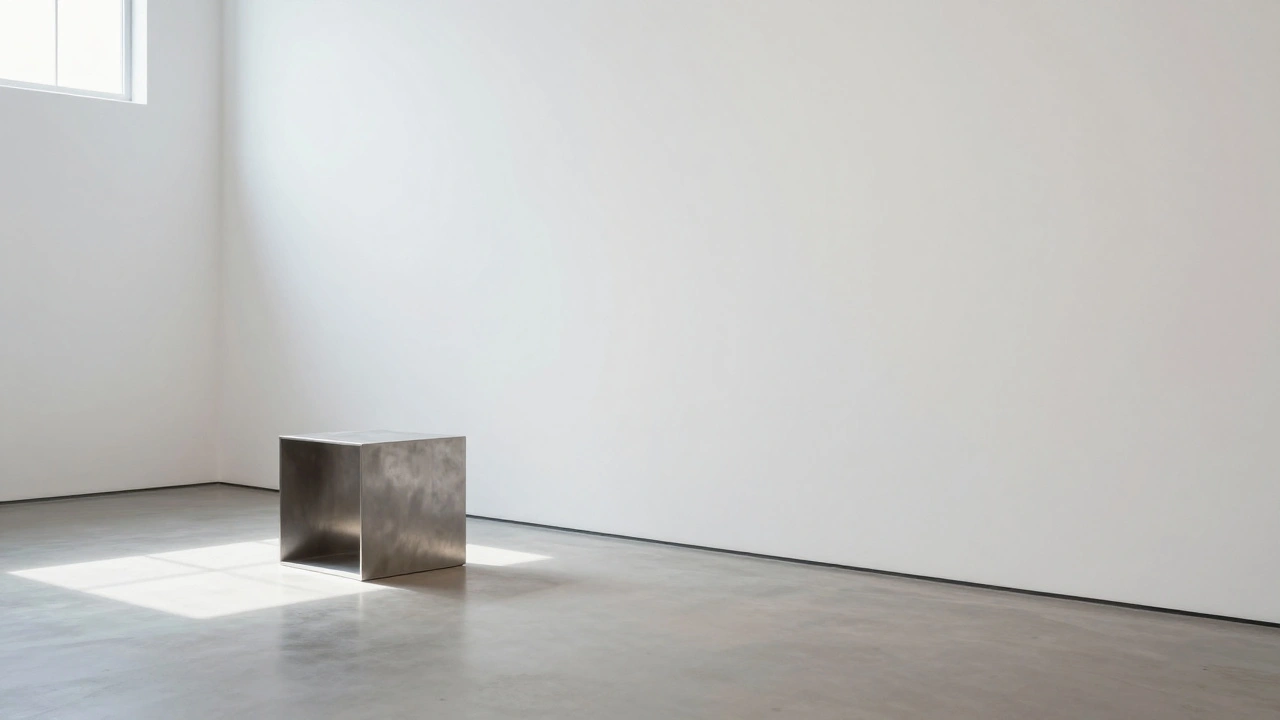
Minimalism in contemporary art isn’t about empty spaces or lack of effort. It’s about stripping away everything that doesn’t matter until only the essential remains. You’ve probably seen it: a single gray square on a white wall, a steel cube in a gallery, or a line drawn across a canvas that takes up half the room. At first glance, it might look like someone skipped the hard part. But that’s the point. Minimalism doesn’t avoid complexity-it distills it.
What Minimalism Really Means in Art
Minimalism as an art movement began in the 1960s, mostly in New York, with artists like Donald Judd, Agnes Martin, and Robert Morris. They were reacting against the emotional chaos of Abstract Expressionism. Instead of brushstrokes that screamed feeling, they wanted objects that simply were. No symbolism. No hidden meanings. No drama. Just form, material, and space.
Think of Donald Judd’s stacked metal boxes. Each one is identical, precisely fabricated, and placed at exact intervals. There’s no brushwork, no signature, no artist’s hand visible. That’s not laziness. That’s control. Every dimension, every angle, every shadow is calculated. The work doesn’t tell you what to feel. It forces you to notice how light hits the surface, how the room changes around it, how your body moves as you walk past.
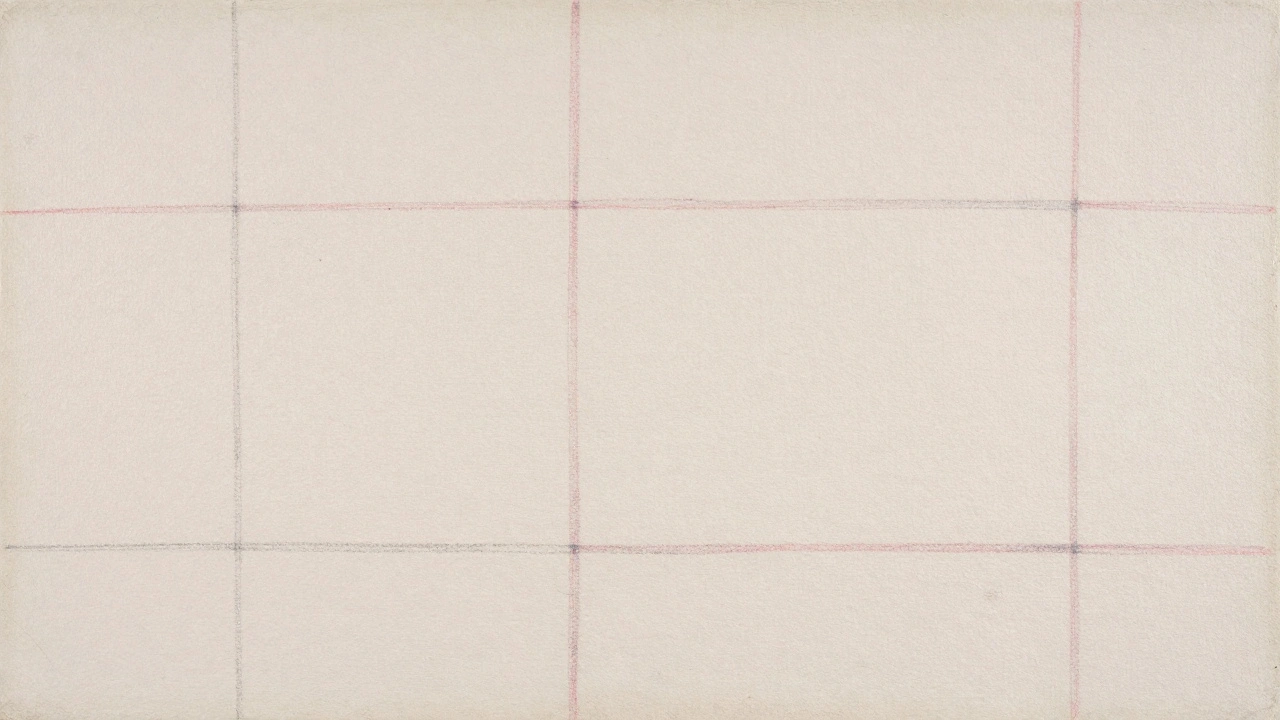
Agnes Martin’s grids are even quieter. Thin pencil lines on canvas, barely visible, sometimes washed with pale washes of color. They look simple, almost childlike. But look closer. Each line is hand-drawn. Each spacing is deliberate. The imperfections aren’t mistakes-they’re proof of presence. Her art doesn’t shout. It whispers. And that’s harder to hear.
Reduction Is Not Deprivation
People often think minimalism means less. But in art, reduction isn’t about taking away. It’s about refining. It’s like removing all the clutter from a kitchen until only the knife, the cutting board, and the sink remain. Suddenly, you notice how the light falls on the steel, how the wood grain catches the edge of the board, how your hand moves without hesitation.
Contemporary minimalist artists don’t remove detail because they can’t create it. They remove it because they know what matters. Take Dan Flavin’s fluorescent light installations. He didn’t paint a picture of light. He used actual fluorescent tubes, arranged in simple geometric patterns. The light isn’t a symbol-it’s the thing itself. The room becomes part of the artwork. The heat from the bulbs, the hum, the way shadows shift as you walk: these aren’t accidents. They’re part of the experience.
That’s why minimalism feels so physical. You don’t just look at it. You feel it. Your body adjusts to the space. Your eyes search for something to hold onto. And when you realize there’s nothing to hold onto, something else happens. You start noticing the silence between the lines. The pause between breaths. The space between you and the object.
Essential Forms: Geometry as Language
Minimalist art loves geometry. Squares. Lines. Cubes. Circles. These aren’t random shapes. They’re universal. A circle exists in nature, in architecture, in human hands. A straight line is the shortest distance between two points-but in art, it becomes a boundary, a limit, a statement.
Carl Andre’s floor sculptures are made of industrial materials: bricks, metal plates, wood blocks. He arranges them in grids or lines. You can walk on them. Some people think that’s disrespectful. Others say it’s the whole point. Art doesn’t have to be on a pedestal. It can be under your feet. The material doesn’t pretend to be something else. It is what it is. Steel is steel. Wood is wood. No illusion. No disguise.
Even in painting, reduction takes shape. Ellsworth Kelly’s color fields aren’t painted with emotion. They’re cut from single sheets of paint-saturated paper and glued to canvas. The edges are sharp. The color doesn’t bleed. It sits there, bold and quiet. A red rectangle isn’t about passion. It’s about redness. Pure, unmediated, undeniable.
Why Minimalism Feels So Modern
Today, we live in a world of constant noise. Notifications. Ads. Infinite scroll. We’re drowning in options, in content, in distractions. Minimalist art doesn’t add to that. It cuts through it. That’s why it feels so relevant now.
Look at the work of artist Rachel Whiteread. She casts the negative space inside objects-the space under a chair, inside a room, beneath a staircase. She doesn’t sculpt the object. She sculpts the emptiness around it. The result? A ghost of what used to be. A memory made solid. It’s not just art. It’s archaeology of the everyday.
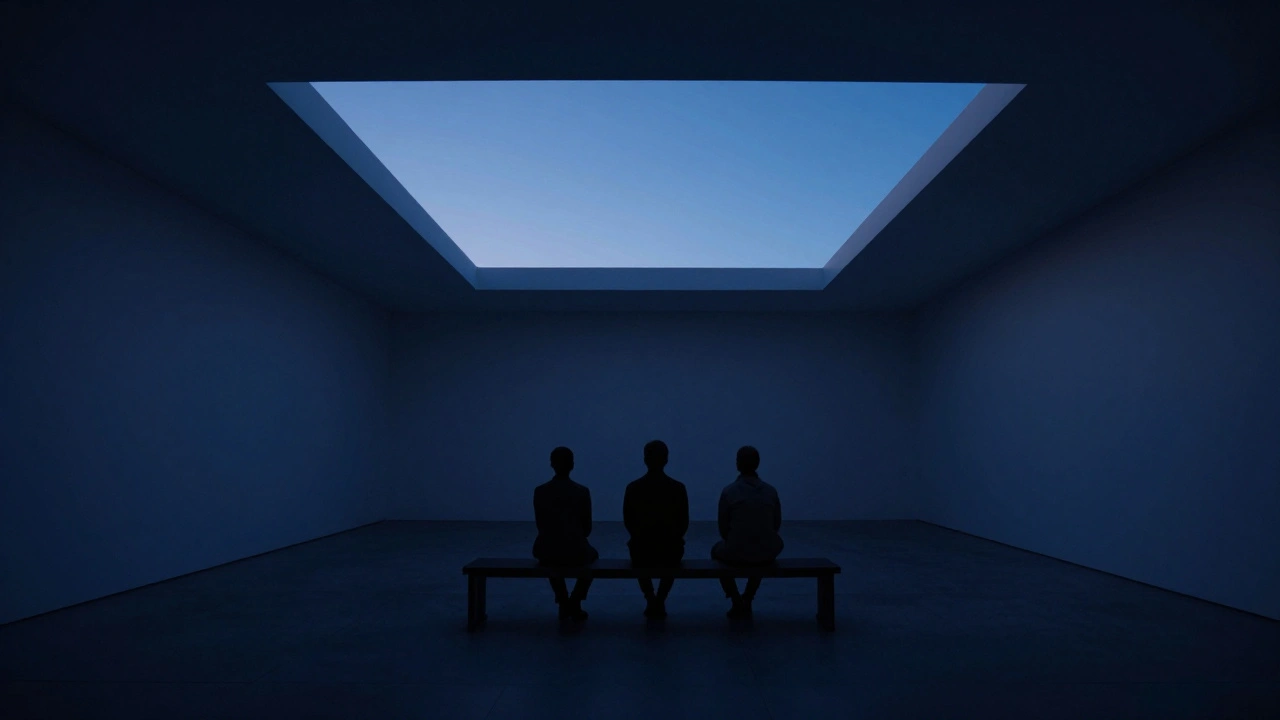
Or consider the installations of James Turrell. He doesn’t use paint or sculpture. He manipulates light and space. In his Skyspaces, you sit in a sealed room with an open ceiling. The sky above becomes a frame, a color field, a changing canvas. As the light shifts from dawn to dusk, your perception shifts. You stop seeing the sky. You start feeling it.
This isn’t decoration. It’s recalibration. Minimalism in contemporary art teaches you to slow down. To look again. To notice what you’ve been ignoring.
What Minimalism Isn’t
It’s not just “simple.” A white canvas with a single black line isn’t minimalist because it’s easy. It’s minimalist because every decision leading to that line was deliberate. Every brushstroke before it was erased. Every alternative was considered and rejected.
It’s not about poverty. Minimalist art often costs more than a traditional painting. Why? Because the materials are precise. The fabrication is industrial. The labor is hidden. A single Judd box can cost hundreds of thousands because it’s made to exact tolerances. No room for error. No room for improvisation.
And it’s not anti-emotional. It’s anti-manipulation. Minimalist art doesn’t try to make you cry. It doesn’t need to. It just asks you to be present. And sometimes, that’s the most emotional thing of all.
Where Minimalism Lives Today
You’ll find minimalist art in major museums-MoMA, Tate Modern, the Guggenheim-but also in small galleries, public plazas, and even corporate lobbies. Companies like Apple and Google use minimalist aesthetics not just in design, but in how they display art. They understand: less distraction means more focus.
In homes, people choose minimalist art not because it’s trendy, but because it works. A single large canvas with one color, or a single steel sculpture in a corner, doesn’t compete with the room. It completes it. It doesn’t demand attention. It earns it.
Even digital art is embracing minimalism. Generative art pieces created with code often rely on simple geometric rules. A line that moves slowly. A dot that pulses. No animation. No sound. Just rhythm. The quietest forms can be the most hypnotic.
Minimalism isn’t going away. It’s becoming more necessary. In a world that never stops talking, sometimes the most powerful thing you can say is nothing at all.
Is minimalist art easy to create?
No. Minimalist art looks simple, but it’s incredibly hard to make. It requires precision, discipline, and deep intention. Removing everything that isn’t essential means you have to know exactly what is essential-and that takes years of practice. Many artists spend decades refining a single idea before they’re ready to reduce it to its purest form.
Why do minimalist artworks cost so much?
Because the craftsmanship is extreme. A Donald Judd sculpture might look like a metal box, but it’s fabricated to millimeter precision using industrial methods. The materials-stainless steel, aluminum, acrylic-are expensive. The labor is hidden but intensive. You’re paying for perfection, not decoration. And in the art world, perfection is rare.
Can minimalist art be emotional?
Absolutely-but not in the way you expect. Minimalist art doesn’t scream joy or sorrow. It creates space for your own emotions to surface. Standing in front of a Dan Flavin light installation, you might feel calm, lonely, or awestruck-not because the art tells you to, but because the environment it creates allows you to feel something real. The emotion isn’t in the object. It’s in your reaction to it.
Is all simple art minimalist?
No. A child’s drawing of a house is simple, but it’s not minimalist. Minimalism requires intentionality. Every line, shape, and material is chosen to eliminate distraction and highlight essence. Simple art can be naive. Minimalist art is rigorous. One is accidental. The other is deliberate.
How do you appreciate minimalist art?
Don’t try to ‘understand’ it. Stand in front of it. Let your eyes adjust. Notice the light, the texture, the space around it. Walk around it. Look at it from different angles. See how your body moves as you shift your position. Minimalist art isn’t about what it represents-it’s about how it changes the way you experience the world around you.