Insurance Basics for Private Art Collections
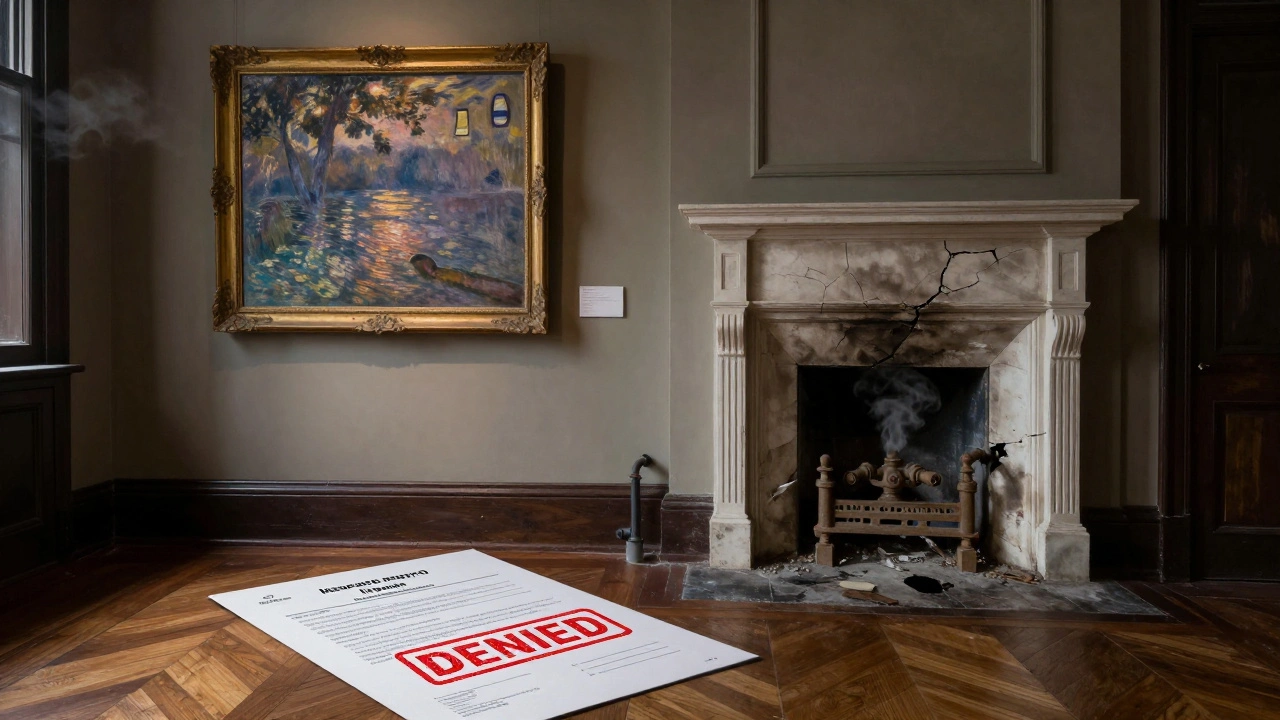
Owning a private art collection is more than a passion-it’s a financial asset. But how many collectors realize their $2 million Picasso isn’t covered by a standard homeowner’s policy? Most don’t. And when a fire, flood, or theft hits, the gap between expectation and reality can cost millions. Art insurance isn’t optional for serious collectors. It’s the only thing standing between your collection and financial ruin.
Why standard home insurance won’t cut it
Standard homeowner’s insurance is designed for everyday belongings-not rare paintings, sculptures, or ancient artifacts. Most policies cap coverage for individual art pieces at $1,500 to $2,500. That’s fine for a poster from a local artist, but useless if you own a 19th-century Monet worth $1.2 million. Even if your policy has a higher overall limit, it often excludes coverage for:
- Accidental damage during transport or handling
- Loss from climate fluctuations (humidity, temperature)
- Damage from improper display or lighting
- Events while the art is off-site (gallery shows, storage, loans)
One collector in Santa Fe lost a $750,000 Jasper Johns after a pipe burst during a winter storm. His insurer denied the claim because the piece wasn’t stored in a climate-controlled vault. That’s not an outlier-it’s the rule.
What art insurance actually covers
Specialized art insurance policies are built for collectors who treat their pieces like high-value assets. These policies typically cover:
- All-risk damage (fire, theft, water, vandalism, accidental breakage)
- Transportation anywhere in the world
- Climate-related damage (even if caused by HVAC failure)
- Loss or damage during exhibitions, auctions, or private viewings
- Restoration costs up to replacement value
Unlike home insurance, art policies don’t pay out based on replacement cost alone. They pay the agreed value-a pre-approved amount you and the insurer set during the appraisal. That means no arguing over market swings after a loss. If your 1967 Warhol was appraised at $4.3 million, you get $4.3 million, even if the market drops.
How to value your collection
Insurance companies won’t take your word for it. You need a professional appraisal. Not just any appraiser-someone with credentials from the Appraisers Association of America or the International Society of Appraisers. They’ll inspect each piece, document provenance, and compare it to recent auction results.
Appraisals aren’t one-time events. Art values change. A piece you bought for $300,000 in 2020 might be worth $700,000 today. Most insurers require updates every 2-3 years. Skipping this step is like driving without a license-you’re risking your entire collection.
One Oregon collector had a 1952 Rothko appraised in 2021 at $1.8 million. By 2025, auction records showed similar works selling for $2.9 million. He updated his policy, then had a fire in his home gallery. He got the full $2.9 million payout. His neighbor, who skipped the update, got $1.8 million-and had to cover the $1.1 million gap out of pocket.

Storage and display matter
Insurance policies don’t just cover the art-they cover how you treat it. Most insurers require:
- Climate control: 70°F ±2°, 50% humidity ±5%
- Security: Alarm systems, motion sensors, and reinforced display cases
- Lighting: UV-filtered LED, no direct sunlight
- Access control: Limited entry, logbooks for handlers
If you hang a 17th-century Dutch oil painting above a fireplace, your insurer will likely deny a claim if the heat causes cracking. Same if you store a sculpture in a damp basement. These aren’t suggestions-they’re policy conditions. Document your setup with photos and sensor readings. You’ll need proof if you ever file a claim.
Choosing the right insurer
Not all insurers understand art. Some treat it like fine jewelry. Others treat it like a car. Look for companies that specialize in fine art and have:
- Experience with collectors in your region
- On-site claim adjusters who know art restoration
- Direct access to restoration labs (like those at the Getty or MoMA)
- Global coverage with no geographic restrictions
Top names in the field include Chubb, Hiscox, and AON’s Art Risk Solutions. Don’t go with a generic provider just because they’re cheaper. The difference in service when disaster strikes can mean the difference between saving a masterpiece and losing it forever.
What to do after you get insured
Getting coverage is step one. Staying protected is step two. Here’s what to do next:
- Keep a digital inventory with high-res photos and appraisals stored in the cloud
- Update your policy every time you buy or sell a piece
- Review your policy annually-coverage limits change, and so do risks
- Train everyone who handles your art: staff, friends, movers
- Know your insurer’s claims process. Ask for a copy of their claim form before you need it
One collector in Chicago kept all her documentation in a locked drawer. When her warehouse flooded, she couldn’t find the appraisal for her $1.4 million Kusama. The insurer delayed payment for six months while they verified value. She lost $200,000 in restoration costs because the delay caused mold to spread.
Common mistakes collectors make
- Assuming their home insurance covers art
- Waiting until after a loss to get an appraisal
- Using unqualified appraisers (like auction house employees without credentials)
- Storing art in garages, basements, or attics
- Not updating coverage after market shifts
- Letting friends or family move art without training
There’s no such thing as "too careful" when it comes to art. Every collector who’s lost a piece without insurance says the same thing: "I didn’t think it would happen to me."
Frequently Asked Questions
Do I need insurance for every piece in my collection?
Yes. Most insurers require you to list each piece individually, especially if it’s worth more than $5,000. You can group lower-value items under a "miscellaneous art" category, but high-value pieces need separate appraisals and coverage. Skipping even one item can void your entire policy if that piece is damaged.
Can I insure art I’m borrowing from someone else?
Yes, but only if you have written permission from the owner and a signed agreement that you’re responsible for its care. Most policies require the owner to be named on the policy or listed as an additional insured. This is common when lending art for exhibitions or private viewings.
How much does art insurance cost?
Typically, it’s 0.5% to 1% of the total insured value per year. For a $2 million collection, that’s $10,000 to $20,000 annually. Factors like location, security, and storage conditions affect the rate. A climate-controlled vault in Portland will cost less than a gallery in Miami with high humidity risk. Some insurers offer discounts for installing approved security systems.
What happens if my art is stolen and later recovered?
If you’ve already been paid, the recovered artwork becomes the insurer’s property. If you haven’t filed a claim yet, you can choose to take it back-but you must return any payment you received. Most collectors opt to keep the payout and let the insurer keep the piece, especially if it’s been damaged or its provenance is compromised.
Can I insure art that’s still in transit?
Yes, and this is one of the biggest advantages of art insurance. Standard policies often exclude transit coverage. A good art policy covers your pieces from the moment they leave your home until they arrive at their destination-whether that’s a gallery in Paris or a storage facility in Zurich. Make sure the policy includes "all-risk" transit coverage and doesn’t exclude "in transit" as a category.