Standard Forms for Galleries: Consignments, Loans, Receipts
Running a gallery isn’t just about hanging art and pouring wine at openings. Behind the scenes, there’s a quiet but critical system of paperwork that keeps everything legal, traceable, and trustworthy. If you’re managing art on behalf of artists, collectors, or institutions, you’re not just a curator-you’re a custodian. And that means you need solid, standardized forms for consignments, loans, and receipts. Skip these, and you’re asking for trouble: disputes, lost pieces, insurance claims gone sideways, or worse-legal liability.
Why Standard Forms Matter
Art is valuable, often irreplaceable, and moves between hands frequently. One gallery in Chicago lost a $120,000 painting in 2023 because there was no signed loan agreement. The collector claimed it was a gift. The gallery had no record. That’s not an anomaly. It’s what happens when you rely on handshakes and email threads.
Standard forms create clarity. They answer the basic questions before they become problems:
- Who owns this piece right now?
- How long can it stay here?
- What happens if it gets damaged?
- Who pays for shipping, insurance, or framing?
- When and how do you get paid?
These aren’t bureaucratic hoops. They’re your first line of defense.
Consignment Agreements: The Foundation
Most galleries work on consignment. An artist gives you their work to sell. You take a commission. Simple? Not if the terms aren’t written down.
A solid consignment form includes:
- Artist details: Full name, contact info, tax ID or EIN
- Artwork description: Title, medium, dimensions, condition notes, photo reference
- Consignment period: Start and end date (usually 6-12 months)
- Commission rate: Clearly stated as a percentage (e.g., 50%)
- Price listing: Minimum acceptable price (no markdowns without approval)
- Storage and insurance: Who covers it? What coverage level?
- Return policy: How and when unsold work is returned
- Termination clause: What happens if the gallery closes or the artist pulls out early?
Some galleries skip the condition report. Big mistake. Even a small scratch that wasn’t documented can turn into a $20,000 dispute. Always photograph the piece from all angles before it goes on the wall. Attach that photo to the form. Sign and date it. Both parties keep a copy.
Art Loans: Temporary Custody, Permanent Responsibility
Loans are different from consignments. Here, you’re borrowing art-not selling it. Maybe it’s for a group show. Maybe it’s from a private collector who wants their piece seen. Or perhaps it’s from a museum sharing a piece with you.
A loan agreement must be tighter than a consignment. Why? Because you’re not earning from it. You’re just holding it. And if something goes wrong, you’re fully liable.
Key elements for a loan form:
- Lender details: Name, address, phone, emergency contact
- Loan duration: Exact start and end dates. No "until further notice"
- Purpose of loan: Exhibition title, dates, location
- Insurance requirements: Minimum coverage amount, approved insurer, policy number
- Handling conditions: Lighting, temperature, humidity, security measures
- Transportation: Who arranges shipping? Who pays? Who is responsible during transit?
- Condition report: Signed before and after. Include close-ups of any existing damage
- Return process: Who picks it up? When? What happens if they don’t show?
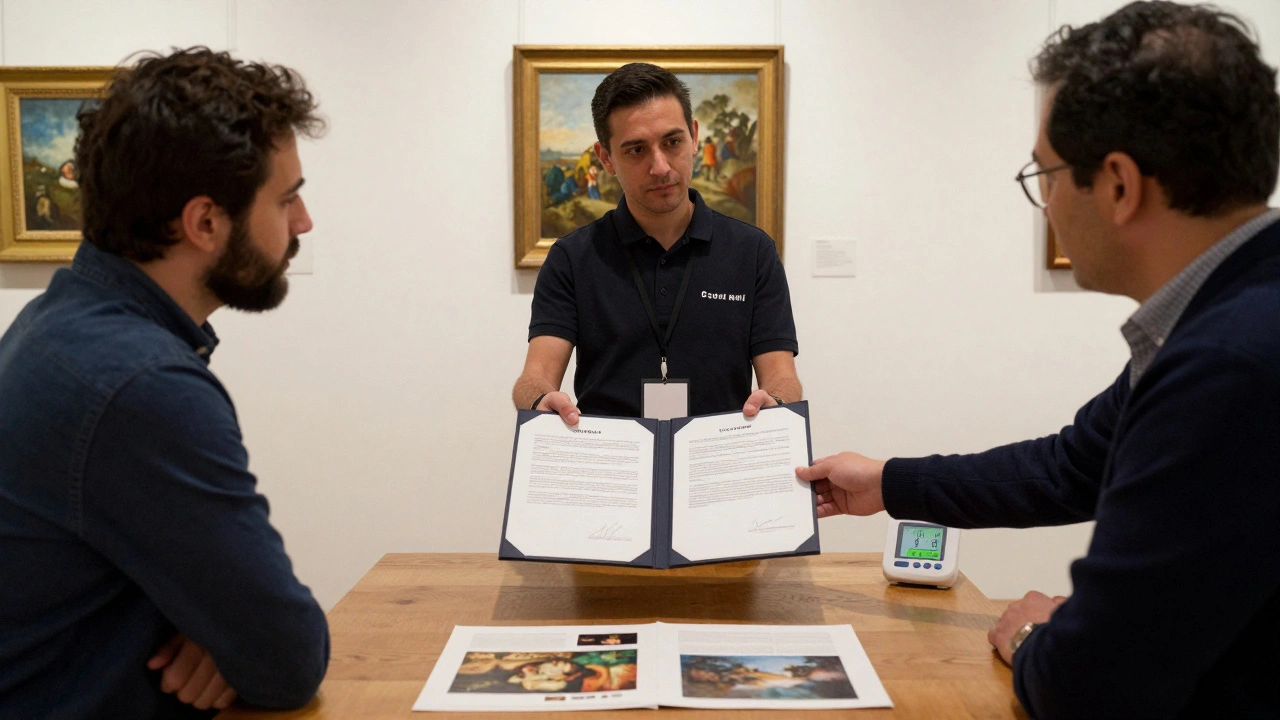
One Portland gallery had a loan from a collector who later claimed the painting was "damaged by UV light"-even though the room had blackout curtains. The loan form had a clause requiring humidity under 50% and light levels below 50 lux. They had logs. They won. Documentation saved them.
Receipts: Proof of Transfer
Receipts aren’t just for sales. They’re for every single time art moves. Whether it’s being shipped out, returned, delivered to a client, or handed off to a conservator-you need a receipt.
A good art receipt includes:
- Date and time of transfer
- From and to: Full names and addresses
- Artwork ID: Use a consistent numbering system (e.g., G-2026-047)
- Condition at handover: "No visible damage," "Minor frame scratch on lower right," etc.
- Signature of recipient: Handwritten or digital. No exceptions
- Tracking number (if shipped)
- Notes: "Delivered to private viewing room," "Held for appraisal," etc.
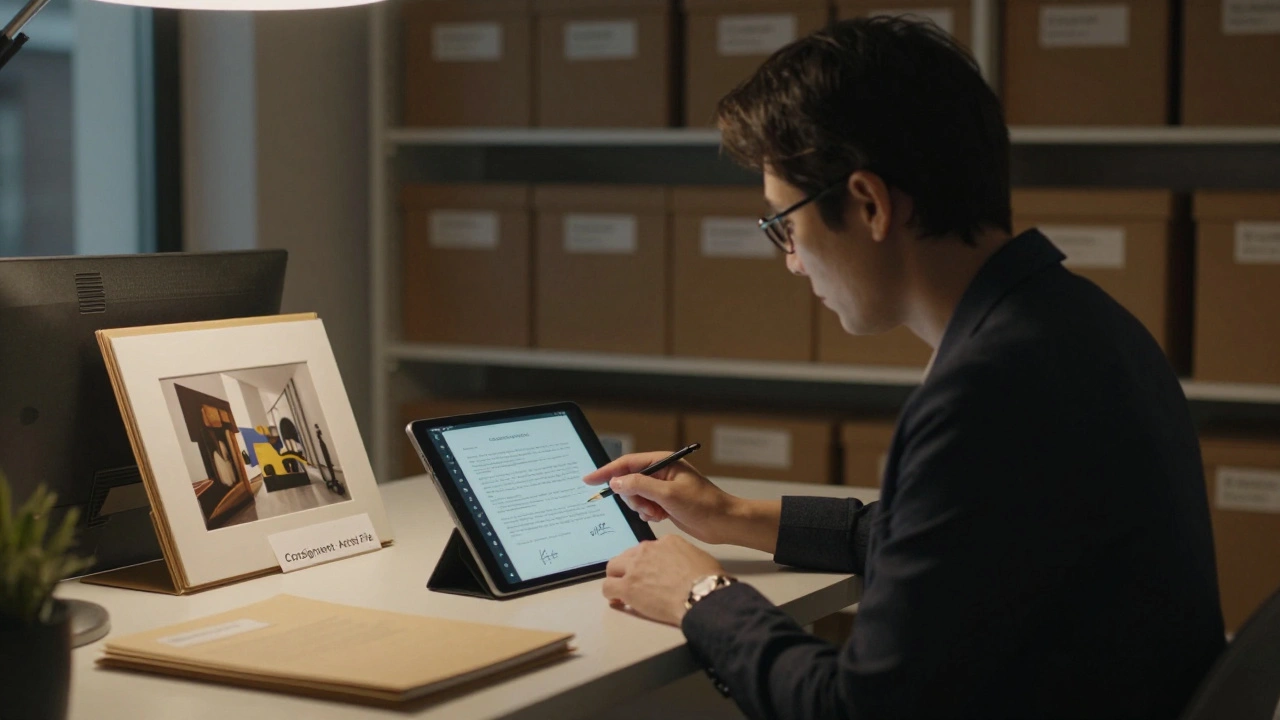
Some galleries use digital signing apps like DocuSign or Adobe Sign. Others still print and hand-sign. Either way, keep a digital backup. Store receipts with the artwork’s file-not in a random folder on your desktop.
Putting It All Together: A Workflow
Here’s how this works in practice:
- An artist brings in 5 new pieces. You fill out a consignment form with condition photos.
- They sign. You both keep a copy. The form gets filed under their name in your digital archive.
- Three months later, you loan one piece to a regional museum. You create a separate loan agreement with their curator. Condition report signed. Insurance certificate attached.
- When the piece leaves your space, you issue a receipt with the shipping carrier and tracking number.
- When it comes back, you issue another receipt. Compare condition. Update the file.
- Six months later, one piece sells. You issue a sales receipt and update the consignment record to reflect the sale and commission paid.
This isn’t extra work. It’s how you avoid lawsuits, insurance denials, and ruined relationships.

Common Mistakes (And How to Avoid Them)
- Using vague language: "Fair market value" isn’t enough. Use actual listed prices or appraisals.
- Forgetting signatures: A form without signatures is just a note. Always get wet or digital signatures.
- Not dating documents: A form dated "2025" is useless if a dispute happens in 2027. Use full dates: MM/DD/YYYY.
- Keeping paper copies only: Fire, flood, or a messy office can erase your records. Scan everything. Store in the cloud.
- Ignoring state laws: Some states require consignment agreements to be notarized. Check your local regulations.
Tools and Templates
You don’t have to build this from scratch. Organizations like the Art Dealers Association of America and the International Association of Art Professionals offer free, downloadable templates. Many galleries use Airtable or Notion to track consignments, loans, and receipts in one place. You can set up automated reminders for expiration dates, return deadlines, and insurance renewals.
Some galleries even integrate these forms into their CRM. When a new artist signs on, the system auto-generates a consignment form. When a loan ends, it sends a reminder to the lender. It’s not fancy-it’s just smart.
Final Thought: Trust Is Built on Paper
Art is emotional. People invest their time, money, and legacy into these pieces. If you want artists to trust you with their life’s work, and collectors to trust you with their treasures-you need systems that prove you’re serious.
Standard forms aren’t about control. They’re about care. They show you respect the art. You respect the people. And you respect the process.
Start small. Pick one form-consignment, loan, or receipt-and make it perfect. Then build from there. Your future self will thank you.
Do I need a lawyer to review gallery forms?
It’s not mandatory, but it’s highly recommended-especially if you’re handling high-value pieces or working across state lines. A lawyer who specializes in art law can help you avoid loopholes. Many regional arts councils offer low-cost legal clinics for galleries. Don’t wait until a dispute arises to find one.
Can I use the same form for consignments and loans?
No. They serve different legal purposes. A consignment implies intent to sell and commission-based payment. A loan implies temporary custody with no sale. Mixing them up can invalidate insurance claims or create tax issues. Always use separate forms.
What if someone refuses to sign a form?
Don’t accept the artwork. No signature means no agreement. It’s not worth the risk. You can explain that the form protects both parties-it’s not about distrust, it’s about clarity. Most artists and collectors understand once you explain why.
How long should I keep these records?
Keep consignment and loan records for at least seven years after the piece leaves your gallery. That covers the statute of limitations for most contract disputes in the U.S. Sales receipts should be kept for tax purposes-usually seven years after the end of the tax year. Digital backups are safer than paper.
Are digital signatures legally binding?
Yes, under the U.S. ESIGN Act and similar laws worldwide, digital signatures are legally equivalent to handwritten ones-as long as they’re tied to a secure, verifiable system. Use platforms like DocuSign, Adobe Sign, or HelloSign. Avoid emailing a PDF and asking someone to type their name.