Shipping and Crating for Traveling Exhibitions: A Practical Guide
Imagine a $2 million oil painting sitting in a crate that’s been rattling around on a truck for three days. The frame is intact, but the canvas? It might be cracked. Or worse, invisible micro-fractures are forming under the varnish that won’t show up until years later. This is the nightmare scenario every curator dreads when dealing with traveling exhibitions is a series of temporary displays where artworks move between multiple venues, requiring specialized logistics to preserve condition. Moving art isn't just about getting it from Point A to Point B; it's a high-stakes operation involving climate control, structural engineering, and precise timing.
If you're curating an exhibition that hops from New York to London to Tokyo, the logistics can eat your budget and your sleep if you aren't careful. The goal here is simple: keep the object safe, keep the cost predictable, and make sure the installation crew isn't standing around waiting for a missing crate. We’ll break down how to handle the physical movement of delicate objects without turning your career into a stress test.
Why Standard Shipping Fails Art
You might think you can just use a standard freight forwarder like you would for office furniture. Don't. Art requires a different level of care because the "product" is often irreplaceable. Standard shipping focuses on speed and cost-efficiency. Art shipping focuses on condition stability. When a painting moves, it experiences vibration, shock, and changes in humidity. If the crate doesn't dampen these forces, the artwork takes the hit.
The biggest enemy isn't usually a drop; it's fluctuation. Humidity swings cause wood frames to expand and contract. Temperature spikes can warp glass or melt certain resins. That’s why conservation packaging is specialized materials designed to buffer artifacts from environmental changes such as humidity, temperature, and physical shock. It’s not just bubble wrap; it’s a system of isolation.
- Vibration: Causes fatigue in mounts and frames over time.
- Shock: Sudden impacts during loading/unloading.
- Climate: Uncontrolled environments in trucks or planes.
The Anatomy of a Proper Crate
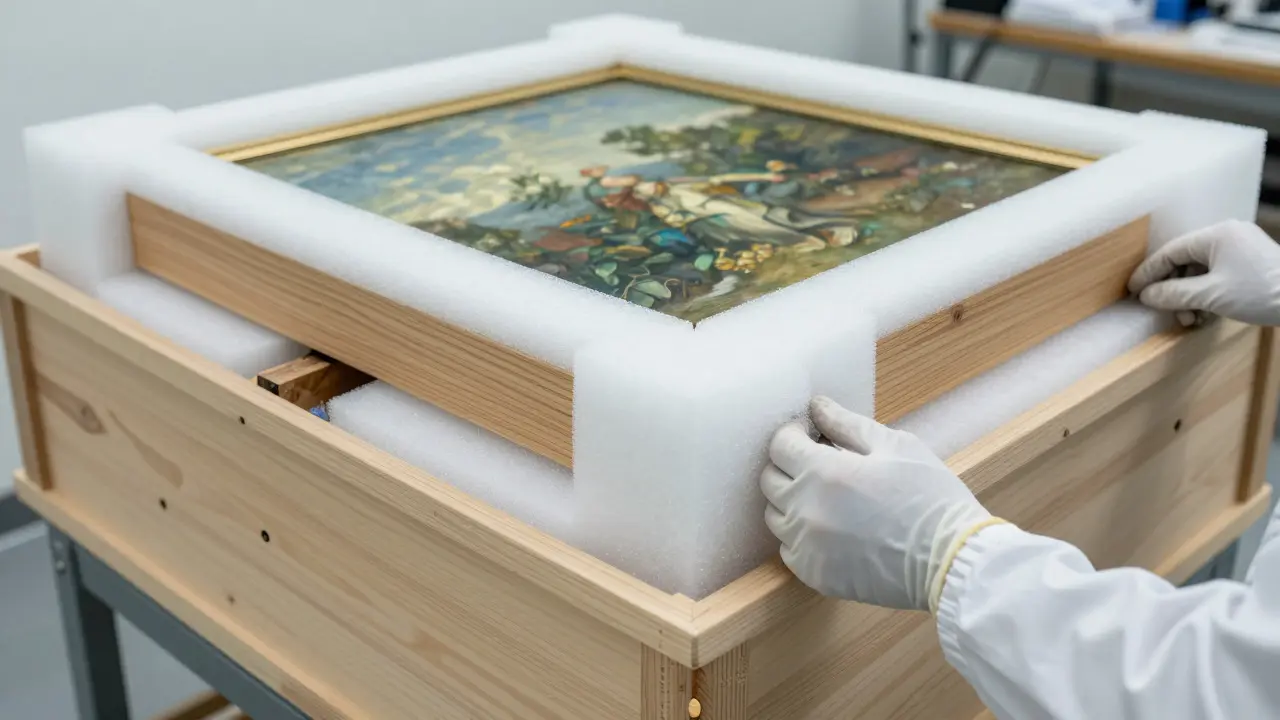
A good crate is a building, not a box. It has three distinct layers: the outer shell, the inner structure, and the cushioning system. Let’s look at what makes each part critical.
- The Outer Shell: Usually made of plywood (often Baltic Birch) or aluminum. For international travel, plywood must be treated or certified to prevent pest spread. Aluminum is lighter but more expensive and harder to repair on-site.
- The Inner Structure: This holds the object. It’s custom-built based on the object’s dimensions. Think of it as a skeleton that supports the weight so the object itself bears no load.
- The Cushioning: High-density foam (like Ethafoam or Plastazote) is the gold standard. It absorbs shock and prevents dust accumulation. Avoid cheap packing peanuts; they migrate and create static electricity, which attracts dust to the artwork surface.
When you build or commission a crate, you need to account for the "access path." Can the conservator get their hands in to check the object without dismantling the whole crate? If the answer is no, you’re adding hours of labor at every stop.
Crating vs. Pre-Fabricated Cases
Should you build custom crates or buy off-the-shelf cases? It depends on the volume and value of the work.
| Feature | Custom-Built Crates | Modular/Off-the-Shelf Cases |
|---|---|---|
| Cost per Unit | High ($500-$2,000+) | Lower initial investment |
| Fit Precision | Perfect fit for specific object | Approximate fit, requires extra padding |
| Reusability | Low (often single-use or limited reuse) | High (designed for hundreds of trips) |
| Best For | Fragile, unique, or large-scale works | Standardized collections, frequent rotators |
| Lead Time | 2-4 weeks for fabrication | Immediate availability |
If you’re moving a set of 50 similar ceramic pieces, modular cases make sense. You buy them once, use them for five years, and save money. But if you’re moving a one-of-a-kind Renaissance panel, a custom crate is non-negotiable. The risk of damage outweighs the upfront cost.
Logistics: The Hidden Cost Centers
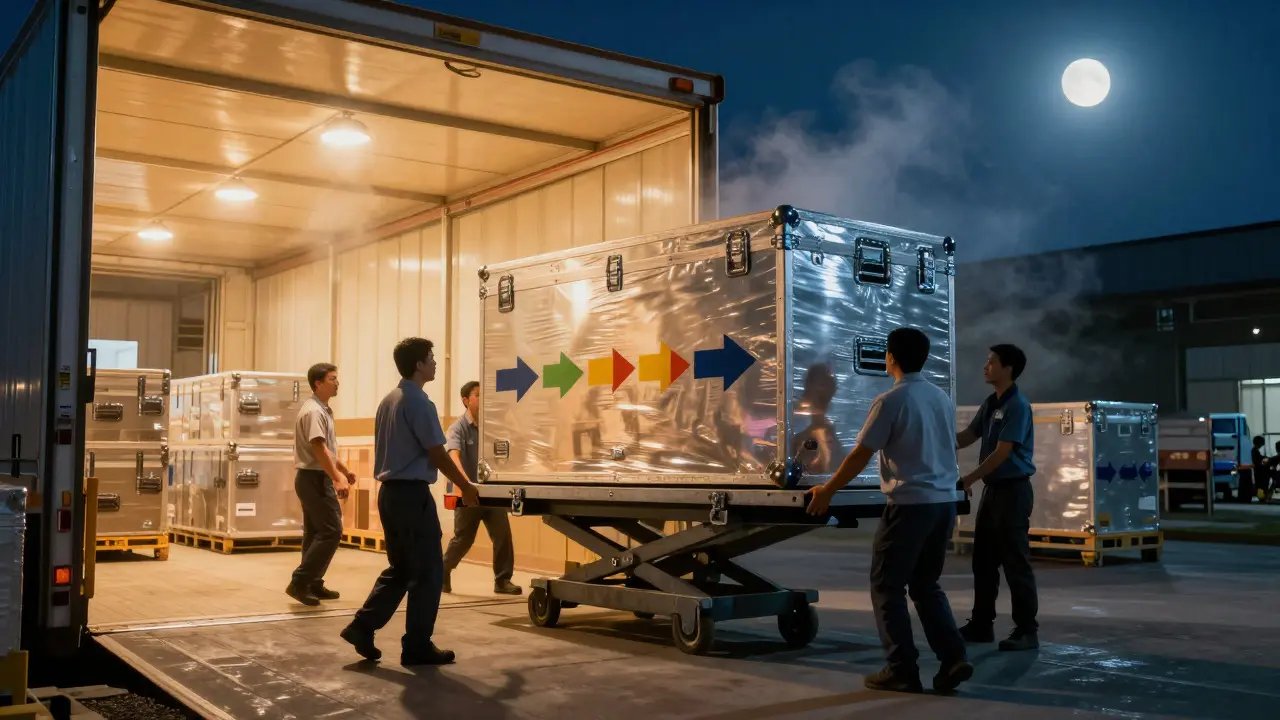
People forget that shipping is 80% paperwork and scheduling, 20% physical movement. Here’s where budgets usually blow up:
- Insurance: You need fine art insurance, not standard cargo insurance. Rates vary by route. Moving within the US is cheaper than transatlantic flights. Always insure for the full replacement value, including restoration costs.
- Customs and Documentation: For international travel, you need export permits, CITES certificates (if natural materials are involved), and detailed condition reports. Missing a stamp can hold a crate at a border for days. Days cost money in storage and crew time.
- Freight Type: Air freight is fast but expensive. Ocean freight is slow but cheap. Road freight is flexible but risky due to potholes and traffic. A hybrid approach (air for the first leg, road for the last mile) is common for major shows.
Pro tip: Schedule "buffer days." If the plane lands Tuesday, don’t schedule installation for Wednesday. Give yourself a day for customs clearance, unloading, and initial inspection. Rushing leads to mistakes.
Condition Reporting: Your Legal Shield
Before anything gets packed, you need a baseline. This is the condition report is a detailed written and photographic record of an artifact's state before transport, used to verify integrity upon arrival. It should include:
- Photographs of all sides, including close-ups of known flaws.
- Written notes on existing cracks, tears, or fading.
- Signatures from both the lender and the shipper.
Without this, if a crack appears after transport, who is at fault? The courier? The museum? The airline? The condition report shifts the burden of proof. Make it digital. Use apps that allow you to timestamp photos and sync them to the cloud instantly. Paper reports get lost; digital ones don't.

Common Pitfalls to Avoid
Even experienced teams slip up. Here are the top three errors we see:
- Over-Packing: Adding too much foam creates air pockets that trap heat. It also makes the crate heavier, increasing fuel costs and lifting risks. Pack tight enough to immobilize, loose enough to breathe.
- Ignoring Weight Limits: Check the floor load capacity of the gallery space. A heavy bronze sculpture might need a steel plate underneath to distribute weight. If the floor fails, the crate is useless.
- Poor Labeling: "Fragile" means nothing to a warehouse worker. Use clear, color-coded labels. Red for "This Side Up," Blue for "Keep Dry," Green for "Handle with Care." Include the installation room number on the outside of the crate.
Final Checks Before Dispatch
Before the truck leaves, run through this checklist. It takes ten minutes but saves thousands.
- Is the crate sealed with industrial tape, not duct tape?
- Are the corner protectors installed?
- Does the label match the manifest exactly?
- Is the condition report signed and filed?
- Has the receiving team confirmed the dock height matches the truck bed?
Traveling exhibitions are complex beasts, but they don't have to be chaotic. By treating the crate as part of the artwork’s home, not just a container, you reduce risk significantly. Focus on precision in the prep phase, and the actual movement becomes much less stressful. The art stays safe, the budget stays intact, and you get to enjoy the show instead of worrying about the logistics.
How long does it take to crate a large artwork?
For a large, fragile piece, expect 1-2 days for professional crating. This includes measuring, building the internal support structure, applying foam, and sealing the outer shell. Simple objects can be crated in hours, but complex sculptures may require a week of planning and execution.
Do I need climate-controlled trucks for short distances?
Yes, even for short distances. Rapid temperature changes can cause condensation inside the crate, leading to mold or warping. Climate-controlled vehicles maintain a stable environment, typically between 65-75°F and 45-55% relative humidity, regardless of external weather conditions.
What is the difference between a crate and a case?
A crate is typically a wooden or metal box built for a specific object or shipment, often semi-permanent or single-use. A case is usually a reusable, standardized container, often made of plastic or aluminum, designed to hold multiple similar items or a specific size range of objects across many trips.
How do I choose the right foam for cushioning?
Use closed-cell foams like Ethafoam or Plastazote. They are acid-free, low-density, and durable. Avoid open-cell foams that shed particles. The density should match the weight of the object; heavier items need denser foam to prevent bottoming out against the crate floor.
Is it worth hiring a specialist art handler?
For high-value or fragile items, absolutely. Specialist handlers know how to lift without stressing joints, how to navigate tight spaces, and how to spot potential hazards. Their insurance coverage is also tailored for fine art, offering better protection than general movers.