Monetizing Art Criticism: Freelance Rates and Rights Explained

Writing about art isn’t just for academics or museum curators anymore. More galleries, online magazines, and independent publishers are hiring freelance critics to shape how people see and value contemporary work. But how much should you charge? And who owns what when you write that review? These aren’t just ethical questions-they’re financial ones.
What Art Critics Actually Do Today
Modern art criticism isn’t limited to dense journal articles or gallery press releases. Freelance critics now write for online platforms like Hyperallergic, Artforum, and smaller independent blogs. They produce exhibition reviews, artist interviews, and contextual essays for collectors, auction houses, and public art programs. Some even create video scripts or podcast transcripts that break down complex work into digestible insights.
Unlike traditional critics tied to newspapers, today’s freelance critic often works on contract. One assignment might be a 1,200-word review for a nonprofit gallery. Another could be a 3,000-word deep dive for a collector’s private newsletter. The scope varies, but the demand is growing.
How Much Do Freelance Art Critics Get Paid?
There’s no universal rate, but based on recent industry surveys from the Art Writers Guild and freelance platforms like Upwork and Contently, here’s what’s actually being paid in 2026:
- Short reviews (500-800 words): $150-$300
- Standard feature (1,000-1,500 words): $400-$800
- In-depth analysis (2,000+ words): $900-$2,000
- Interviews or profiles: $500-$1,200
- Monthly retainer (4-6 pieces/month): $2,500-$5,000
Top-tier critics with established reputations-especially those who write for major publications-can command $2,500 per piece or more. But most freelancers start in the $300-$600 range. Payment often depends on the client’s budget, the publication’s reach, and whether the piece includes exclusive access to the artist or studio.
Some clients pay upfront. Others pay on publication. A few still expect work for exposure. Don’t fall for that. Exposure doesn’t pay rent. If a client can’t afford to pay, they shouldn’t be asking for professional criticism.
Who Owns the Review? Copyright and Rights
This is where things get messy. Many clients assume that paying for a review means they own it. That’s not true-unless you sign it away.
Under U.S. copyright law, you automatically own the copyright to anything you write, unless you’re an employee or you sign a contract transferring those rights. That means:
- If you write a review and the gallery publishes it, you still own the copyright.
- You can republish it on your own website, portfolio, or in a future anthology.
- You can pitch the same idea to another outlet-just not the exact same text.
But here’s the catch: most contracts include a license. That’s not the same as ownership. A typical license might say:
- “Client receives exclusive rights to publish the piece for 6 months.”
- “You may republish after 12 months with attribution.”
Always read the fine print. If a contract says “all rights transferred,” walk away-or negotiate. You can offer a non-exclusive license instead. That way, you keep control. You can even charge more for exclusive rights.
Some clients will ask for “work for hire.” That’s a red flag. It means they own everything, forever. It’s common in corporate settings but rare in art criticism. If they insist, demand triple your normal rate. It’s not worth giving up your intellectual property for less than that.
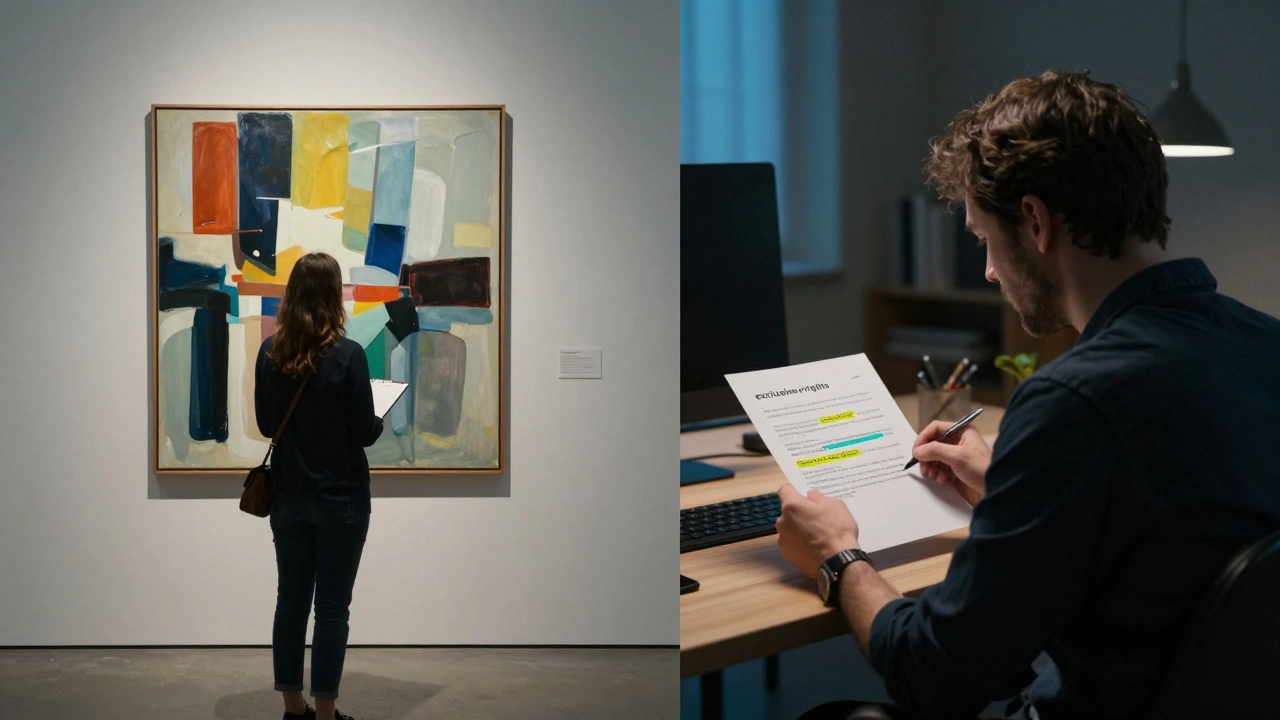
How to Protect Yourself Before You Write
Don’t start writing until you have a clear agreement. Here’s what to ask for:
- Payment terms: When and how will you be paid? Net 30? Upfront deposit? Wire transfer or PayPal?
- Usage rights: Will they use it once? Republish? Translate? Adapt into video?
- Attribution: Will your name appear? With a bio? A link to your site?
- Revisions: How many rounds of edits are included? Unlimited changes should cost extra.
- Exclusivity window: How long before you can reuse the content elsewhere?
Use a simple contract template. The Art Writers Guild offers free downloadable ones. Don’t rely on email confirmations. A signed PDF counts.
Where to Find Work
There’s no central job board for art critics, but here’s where real opportunities show up:
- Artforum’s Classifieds: Lists paid gigs from galleries and museums.
- Artspace: Curates freelance opportunities for writers and editors.
- LinkedIn: Follow galleries, art foundations, and editors. Many posts go unnoticed.
- Substack: Start your own newsletter. Build an audience. Then pitch to larger outlets.
- University art departments: They often need writers for exhibition catalogs and public programs.
Don’t wait to be hired. Pitch. Send a short, sharp idea to an editor you admire. Example: “I’d like to write about the rise of AI-assisted sculpture in Berlin-here’s why it matters.” If they like it, they’ll pay.

What to Avoid
There are traps. Watch out for:
- “Exposure-only” gigs: If a gallery has no budget, they shouldn’t be asking for professional criticism. Offer a free short post if you want, but don’t make it a habit.
- Conflicts of interest: Never review an artist you’re friends with, represent, or have a financial stake in. It undermines your credibility.
- Writing under pressure: Rushed reviews are lazy reviews. If a client demands a piece in 24 hours, charge 50% more-or say no.
- Signing vague contracts: If it says “all rights” or “perpetual license,” ask for clarification. If they can’t explain it, walk away.
Building a Sustainable Career
Monetizing art criticism isn’t about landing one big gig. It’s about building a portfolio, a reputation, and a system.
Keep a record of every piece you write: where it was published, how much you were paid, what rights you kept. Use that data to raise your rates. After five published pieces at $500 each, you can reasonably ask for $750 next time.
Also, diversify. Don’t rely on one outlet. Mix gallery commissions, magazine features, podcast scripts, and even educational content for art schools. The more formats you work in, the more stable your income becomes.
And never stop reading. The best critics don’t just write-they consume. Visit exhibitions. Read theory. Talk to artists. Your voice gets sharper when you’re deeply engaged.
Frequently Asked Questions
Can I republish my art review on my own website?
Yes-if you didn’t sign away your rights. Under U.S. copyright law, you own your writing unless you transfer ownership in writing. Most clients only ask for a license to publish, not ownership. Check your contract. If it says “exclusive rights for 6 months,” you can republish after that period. Always credit the original publication.
How do I negotiate a higher rate?
Start by knowing your worth. Track your past payments and compare them to industry benchmarks. If you’ve written for reputable outlets, mention them. Offer to deliver faster, include research, or add photos. If they want exclusivity, charge 50% more. Never accept the first offer. Most clients expect negotiation.
Is there a difference between writing for online vs. print publications?
Yes. Online outlets often pay less per word but have faster turnaround and wider reach. Print journals pay more but have longer cycles and smaller audiences. Some critics prefer print for prestige. Others choose online for volume and speed. The best strategy is to mix both.
Can I write about artists I know personally?
Technically yes-but it’s risky. If you’re close to the artist, your review will be seen as biased, even if it’s fair. Most serious outlets require full disclosure. Some won’t publish it at all. If you do write about someone you know, be transparent. State your relationship upfront. Better yet, decline the assignment and recommend another critic.
What if a client refuses to pay?
Send a polite reminder with a deadline. If they still don’t pay, send a final notice citing your contract. If that fails, small claims court is an option for amounts under $10,000 in most states. Keep all communication, drafts, and payment agreements. Many freelance writers have recovered unpaid fees this way.