Light Metering for Galleries: Lux Targets by Medium
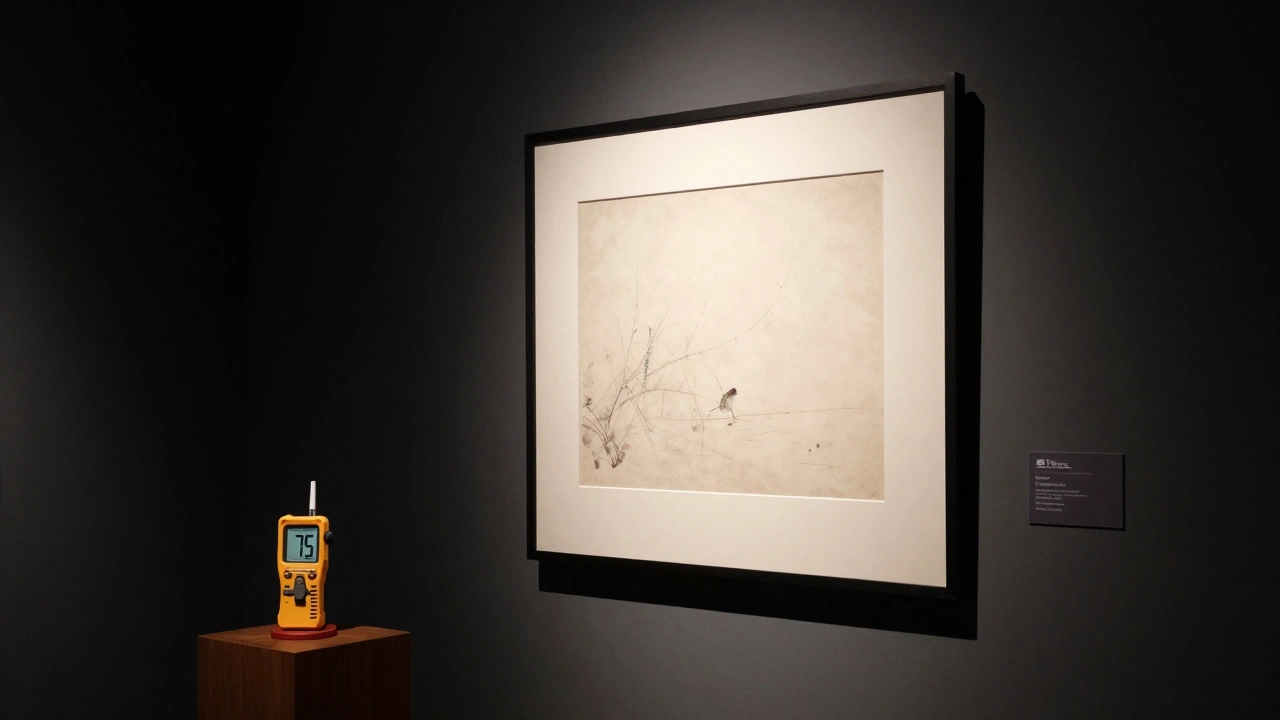
Getting the light right in a gallery isn’t about making things look bright-it’s about making art feel alive. Too much light bleaches colors and fries delicate surfaces. Too little, and viewers strain to see brushstrokes or texture. The difference between a powerful experience and a forgettable one often comes down to one number: lux. But what lux level should you aim for? It depends entirely on what’s on the wall.
Why Lux Matters More Than Brightness
Lux measures how much light falls on a surface. It’s not about how bright the bulb is-it’s about how much of that light actually hits the painting, photograph, or sculpture. A 100-watt LED might seem powerful, but if it’s mounted too high or angled wrong, the surface might only get 150 lux. That’s not enough for a detailed oil painting. On the other hand, a 30-watt LED positioned just right can deliver 200 lux-perfect for a watercolor.
Most galleries still guess. They use the same lighting for everything: big, bright, white LEDs. But that’s like using the same hammer for nails, screws, and glass. Different mediums need different light. The International Council of Museums (ICOM) and the Illuminating Engineering Society (IES) have spent decades testing what actually preserves art while letting people see it clearly. Their data is clear: there’s no one-size-fits-all number.
Lux Targets for Different Art Mediums
Here’s what works based on real-world testing in galleries from London to Chicago to Portland:
- Oil paintings: 150-200 lux. This range brings out depth and texture without overheating the varnish. Above 200 lux, colors start to fade faster-especially reds and yellows. Below 150, details vanish.
- Watercolors and drawings on paper: 50-100 lux. These are fragile. Even 150 lux can cause yellowing in just five years. At 75 lux, you get enough visibility for fine lines while keeping the paper stable for decades.
- Photographs (especially vintage prints): 75-120 lux. Silver-based prints (like old gelatin silver prints) are sensitive to UV and heat. Keep it under 120. Modern inkjet prints can handle up to 150, but only if the light is filtered for UV.
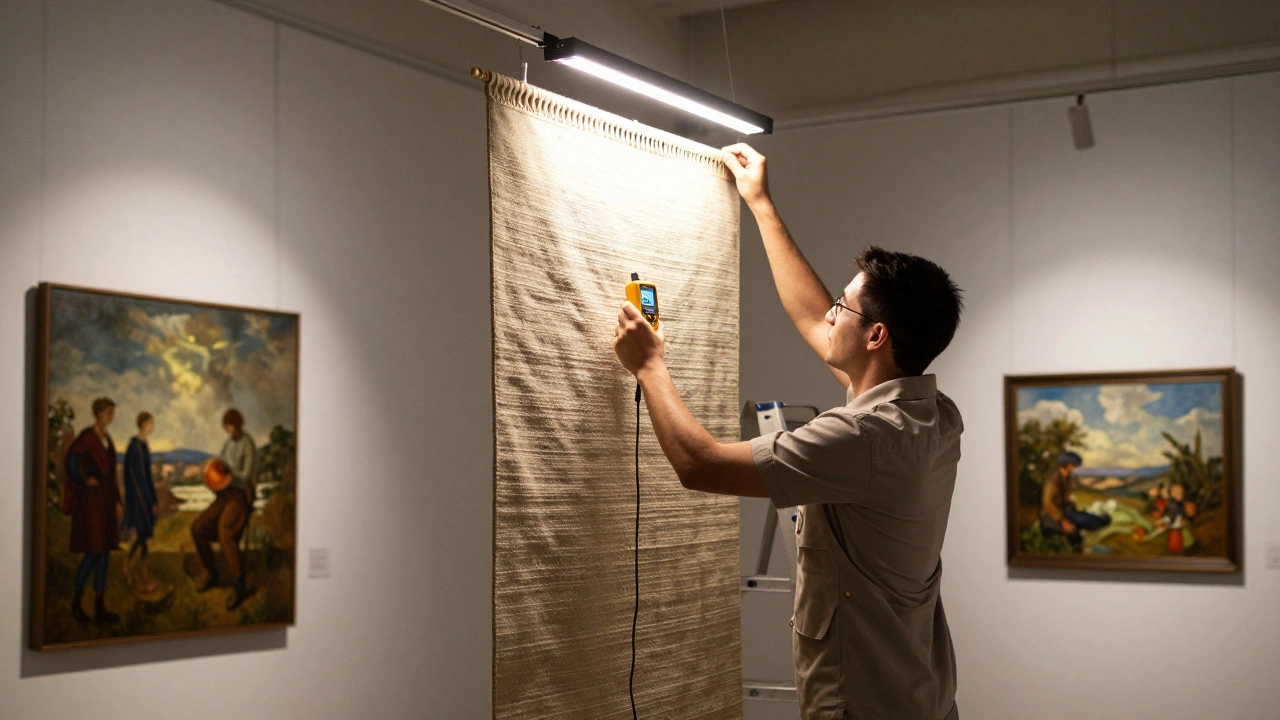
- Textiles and tapestries: 100-150 lux. Dyes in silk and wool fade fast under high light. A 120 lux level lets you see intricate patterns without accelerating decay. Always use directional lighting so light doesn’t hit the fabric from above.
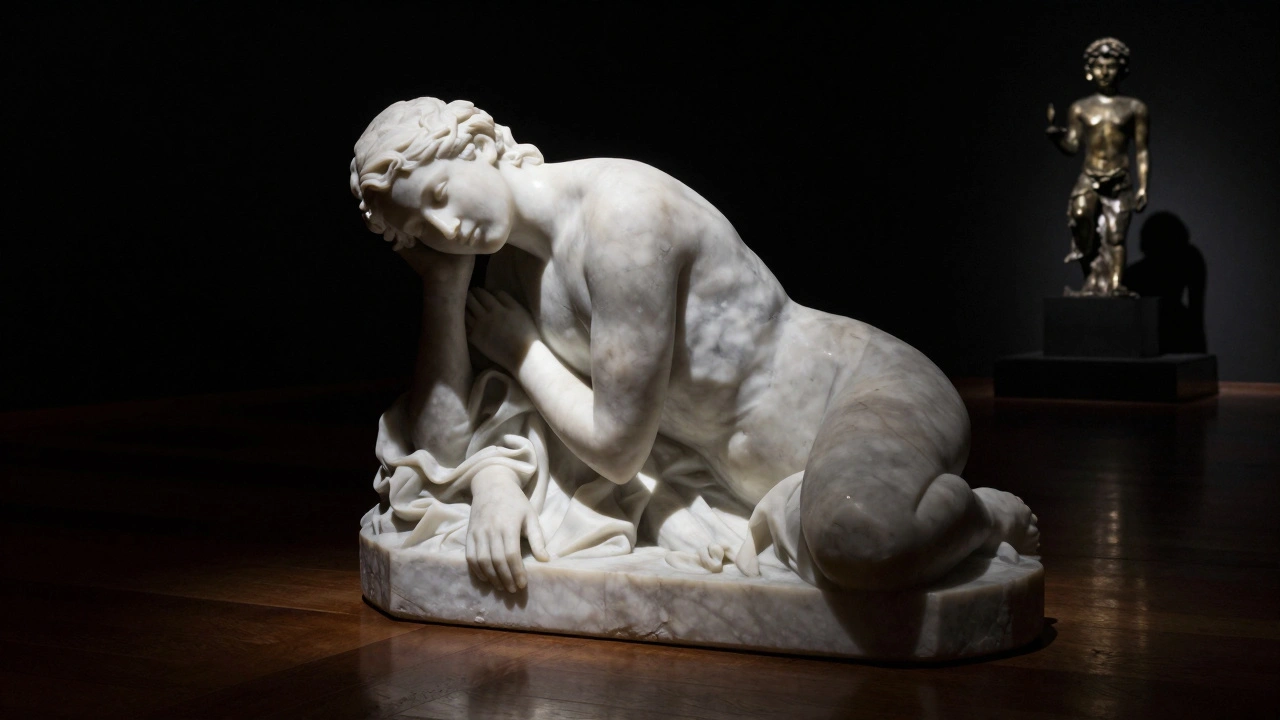
- Sculpture (stone, bronze, ceramic): 200-300 lux. These materials don’t degrade from light, so you can go higher. The goal here is contrast. A 250 lux spotlight on a marble bust creates shadows that reveal its form. Avoid flat, even lighting-it kills dimension.
- Contemporary mixed media (plastic, acrylic, digital): 200-300 lux. Modern materials are more durable, but some plastics yellow under UV. Use LEDs with a CRI above 90 and UV filters. Digital screens need 300 lux to be readable in ambient gallery light.
How to Measure Lux in Your Gallery
You can’t eyeball this. A phone app won’t cut it. You need a handheld lux meter-something like the Extech LT200 or a Sekonic L-308. Here’s how to do it right:
- Turn off all artificial lights except the ones you’re testing.
- Place the meter flat against the surface of the artwork-where a viewer’s eyes would naturally focus.
- Take three readings: center, left edge, right edge.
- Average them. If the spread is more than 50 lux, you need to adjust the angle or height of the light.
- Repeat for every piece. Don’t assume all paintings on one wall get the same light.
Many galleries measure at the floor, not the art. That’s wrong. Light drops off fast with distance. A light that gives 200 lux at the painting might only give 40 lux at floor level. The viewer’s eye is at the art-not the floor.
Common Mistakes That Ruin Art Lighting
Even well-funded galleries mess this up. Here’s what goes wrong most often:
- Using daylight-balanced LEDs everywhere. They look clean, but they’re full of blue light, which accelerates fading. Use warm white (2700K-3000K) for delicate works.
- Installing recessed lighting without dimmers. Fixed brightness means you can’t adjust for changing exhibitions. Always use 0-100% dimmable drivers.
- Over-lighting sculpture with floodlights. Flat light flattens form. Use narrow-beam spotlights (10°-20° beam angle) to sculpt shadows.
- Ignoring UV filters. Even LEDs emit a little UV. Install UV-filtering sleeves on all fixtures, especially near paper and textiles.
- Not measuring after installation. A fixture that looks right in the showroom might cast uneven light in your space. Always verify with a meter.
Real-World Example: A Portland Gallery’s Fix
A small gallery in Portland’s Pearl District had a recurring complaint: visitors said their 19th-century watercolor collection looked dull. They’d upgraded to high-CRI LEDs, but the problem persisted. They measured the lux-and found readings between 180 and 220 on the paper. That’s double what’s safe.
They replaced the fixtures with adjustable track lights, lowered them by 18 inches, added UV filters, and dialed the brightness down to 85 lux. Within weeks, visitor feedback changed. People started noticing fine ink lines and subtle tonal shifts they’d never seen before. The conservator reported no new signs of fading in the past 18 months.
It’s Not Just About the Numbers
Lux targets are a starting point. The real art is in how you use light to guide attention. A spotlight on a single brushstroke in a Van Gogh can make someone stop and stare. A gentle wash of light across a tapestry can invite the eye to wander. Light should never shout-it should whisper.
Think of lighting as part of the curation. Just like you choose which pieces to display, you choose how to reveal them. The right lux level doesn’t just protect art-it transforms how people connect with it.
What’s the maximum lux level for any artwork?
The absolute maximum should never exceed 300 lux, even for durable materials like stone or metal. Anything above that increases the risk of cumulative damage over time, especially from UV and heat. Most institutions cap permanent displays at 200 lux, with temporary exhibits going up to 300 only if they’re shown for less than six months.
Can I use smart lighting systems in galleries?
Yes-but only if they’re calibrated and monitored. Many smart systems adjust brightness based on room occupancy or daylight. That’s dangerous for art. A sudden jump from 100 to 250 lux could damage sensitive works. Use smart systems only for non-sensitive areas like hallways. For galleries, stick to manual, fixed settings with scheduled dimming cycles.
Do LED lights really cause less damage than halogen?
Yes, but not because they’re "cooler." Halogens emit far more infrared heat and UV radiation. LEDs can still emit UV if they’re low-quality. The key is choosing LEDs labeled "UV-free" or "museum-grade," with a CRI above 90 and a color temperature under 3000K. Always pair them with UV-filtering acrylic covers.
How often should I re-measure light levels?
Measure every time you change an exhibition. Also check annually, even if nothing changes. Bulbs dim over time. Fixtures get dusty. Even a 10% drop in output can make a piece look dull. Keep a log: record the date, lux readings, and bulb type. This helps you track degradation and plan replacements.
Is natural light ever acceptable in galleries?
Only if it’s strictly controlled. North-facing windows with UV-filtering film, blackout shades, and light-diffusing blinds can work for short-term exhibits. Never use direct sunlight. Even indirect daylight fluctuates wildly-100 lux one hour, 500 the next. That’s harmful. Most museums avoid natural light entirely for permanent collections.