Insurance Documentation for Art: Photos and Records
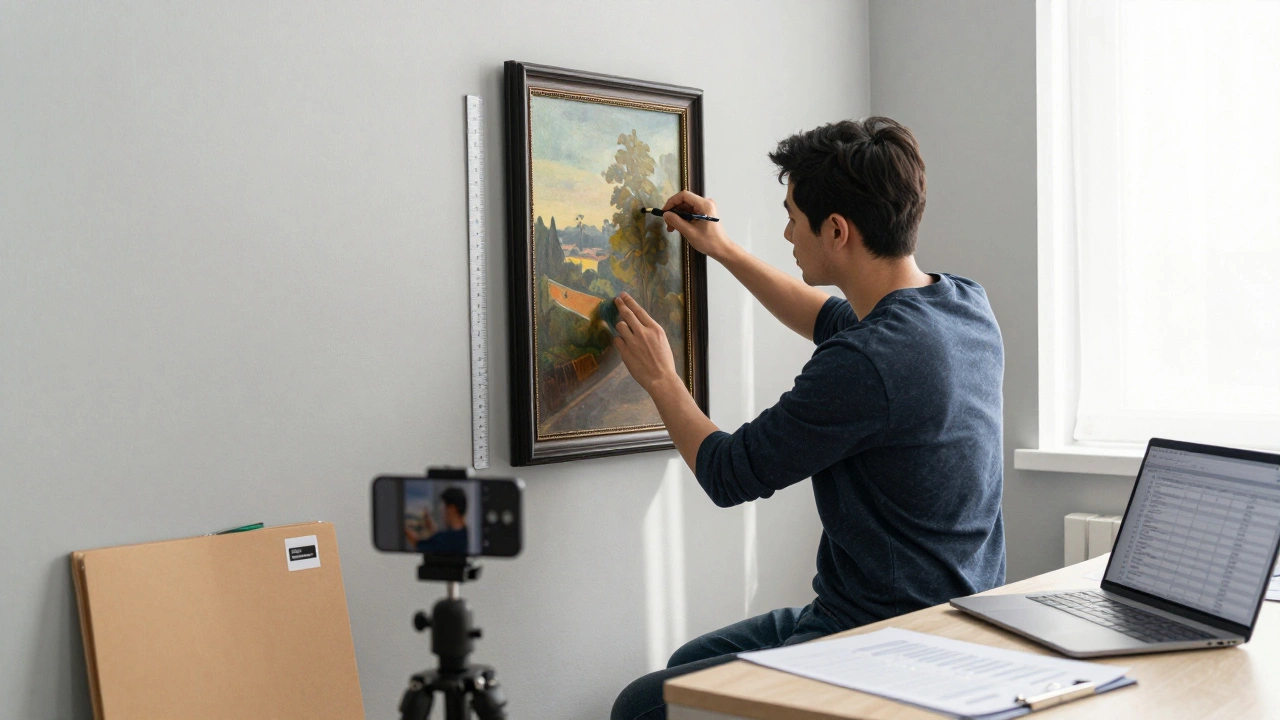
When you own valuable art, it’s not just about hanging it on the wall. It’s about protecting it. If a fire breaks out, a pipe bursts, or a piece gets stolen, your insurance company won’t just take your word for it. They’ll ask for proof-detailed, clear, and organized proof. That’s where art documentation comes in. Without it, getting paid after a loss can turn into a months-long nightmare. The good news? Setting up solid documentation doesn’t require an art expert or a big budget. Just a camera, a spreadsheet, and a little time.
Why Photos and Records Matter More Than You Think
Insurance claims for art aren’t like car or home claims. You can’t just show a receipt and call it a day. Art is unique. No two pieces are alike. A painting by a local artist might be worth $2,000 today, but if that artist suddenly gains fame, its value could jump tenfold. Insurance companies know this. They don’t guess. They verify.
Take the case of a collector in Seattle whose home flooded in 2023. He had three pieces insured. He remembered their names, the artists, even where he bought them. But he had no photos. No condition reports. No appraisals. The insurer offered $1,500 per piece-based on old listings he hadn’t updated in years. He lost over $18,000 because he didn’t document what he owned.
Documentation isn’t about being paranoid. It’s about being prepared. A photo isn’t just a picture. It’s proof of ownership. It’s proof of condition. It’s proof of value.
What to Photograph: The 5 Must-Have Shots
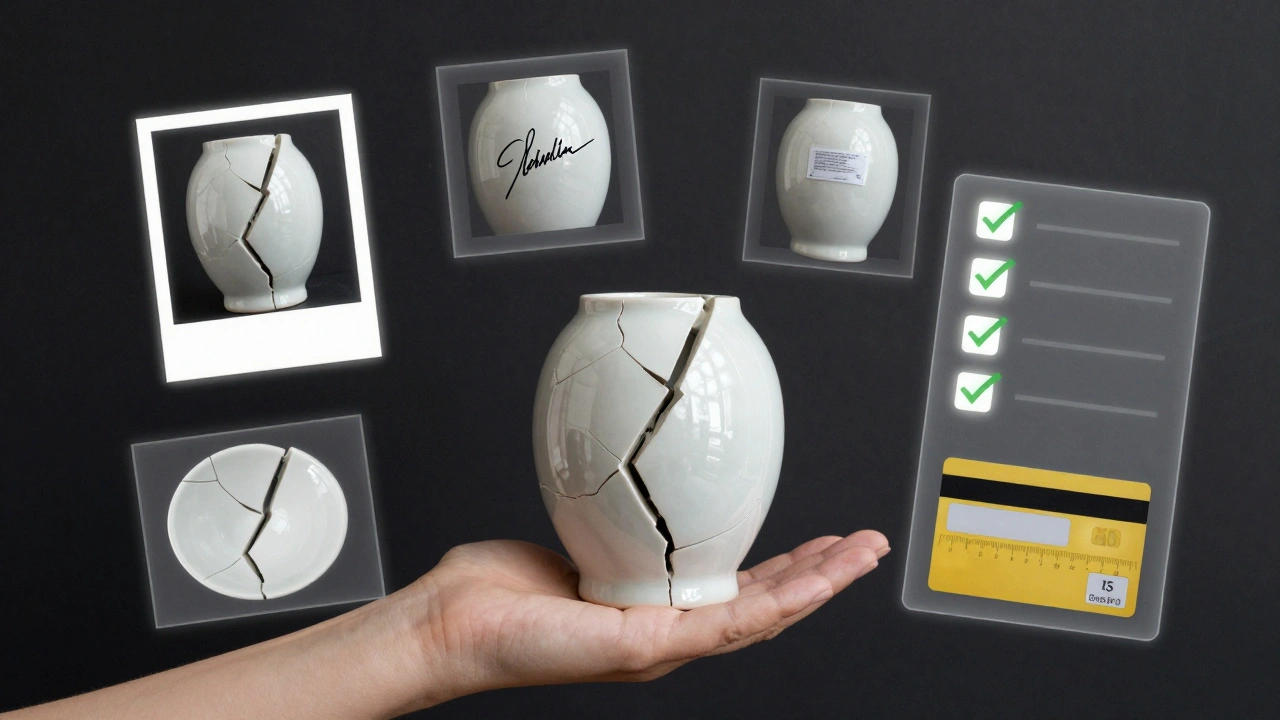
Don’t just snap one quick picture and call it done. You need multiple angles, context, and detail. Here’s what to capture for every piece:
- Full view: Stand back and photograph the entire artwork in natural light. Include part of the wall or frame to show placement.
- Close-up of signature and date: Many artists sign in the corner. Zoom in so the signature is legible. If there’s a date, capture that too.
- Backside: Flip the piece (if safe) and photograph the reverse. Look for labels, stamps, gallery tags, or provenance notes. These are gold for appraisers.
- Condition details: Use your phone’s macro mode to photograph scratches, cracks, fading, or restoration work. Even minor damage matters.
- Measurement shot: Place a ruler or standard-sized object (like a credit card) next to the piece. This helps insurers estimate size without seeing it in person.
Store these photos in a folder labeled by artist and title. Use consistent naming: Smith_John_Sunset_01.jpg. Avoid vague names like IMG_1234.jpg. If you’re unsure, take five shots instead of three.
Building Your Art Inventory: The Spreadsheet That Saves You
Photos alone aren’t enough. You need a record. A simple spreadsheet works better than fancy apps. Here’s what to include in every row:
| Field | What to Include | Why It Matters |
|---|---|---|
| Artwork Title | Exact name as signed or labeled | Helps match photos to insurance records |
| Artist Name | Full legal name, not nickname | Crucial for provenance and valuation |
| Date Created | Year or range if unknown | Affects historical value |
| Medium | Oil on canvas, bronze sculpture, lithograph, etc. | Determines handling and restoration needs |
| Dimensions | Height x Width x Depth in inches or cm | Needed for shipping, storage, and display |
| Acquisition Date | When you bought or received it | Helps establish ownership timeline |
| Purchase Price | Original cost, including fees | Baseline for insurance coverage |
| Current Appraised Value | Updated value from a certified appraiser | What your insurer will base coverage on |
| Appraiser Contact | Name, firm, phone, email | Insurers may call them directly |
| Location | Room, wall, display case, storage unit | Helps assess risk (e.g., basement vs. attic) |
| Insurance Policy Number | Which policy covers this piece | Speeds up claims processing |
| Photo File Name | Link to the folder with your shots | One-click access during claims |
Update this every 12 to 18 months. Art values change. A piece you bought for $3,000 five years ago might now be worth $12,000. If you don’t update your records, you’re underinsured. And underinsurance means you pay out-of-pocket when disaster strikes.
Appraisals: When and Why You Need Them
You don’t need an appraisal for every $200 print. But for anything over $1,000-or anything with auction history-you do. A certified appraiser (not a gallery owner) gives you a written report with:
- Photographs of the piece
- Condition assessment
- Market analysis (recent sales of similar works)
- Signature verification
- Statement of value with date
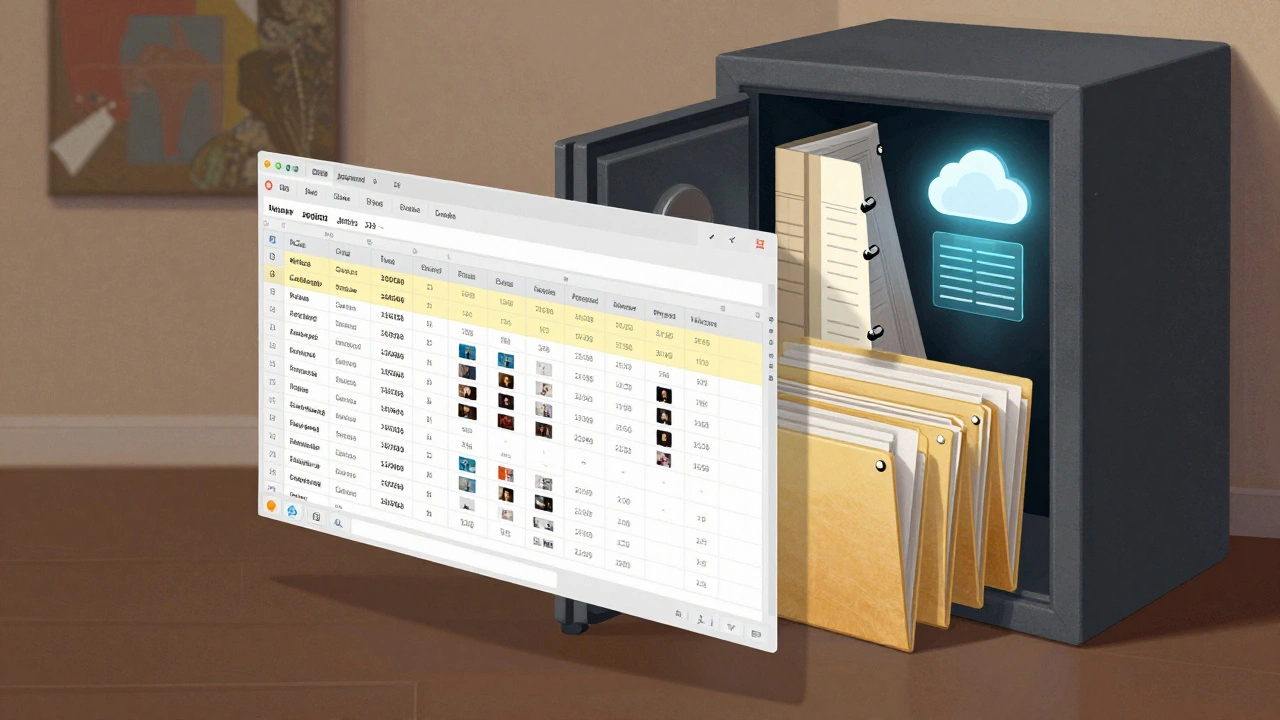
Most insurers require an appraisal every three years. Some high-value policies require annual updates. Don’t wait for a claim to find out your appraisal expired. Keep digital and printed copies in a fireproof safe or cloud backup.
Look for appraisers certified by the American Society of Appraisers or a nonprofit organization that sets standards for fine art valuation. Avoid appraisers who charge a percentage of value-it creates a conflict of interest.
Where to Store Your Documentation
Don’t keep everything on your laptop. If your house burns down, your hard drive might too. Use the 3-2-1 rule:
- 3 copies: One on your computer, one on an external drive, one in the cloud.
- 2 formats: Digital (PDF, spreadsheet) and physical (printed binder).
- 1 offsite: Store a printed copy with your lawyer, in a safety deposit box, or with a trusted friend.
Cloud storage should be encrypted. Use services like Google Drive, Dropbox, or iCloud with two-factor authentication. Label your folders clearly: Art_Inventory_2026. Back it up quarterly.
For physical copies, use a waterproof, fire-resistant binder. Include a table of contents. Add a cover letter: This document contains inventory of all insured artwork. Contact [your name] or [insurer] in case of loss.
What Happens When You File a Claim
When you call your insurer after damage or theft, they’ll ask for:
- Photo evidence of the piece before the loss
- Your inventory spreadsheet
- Appraisal report
- Proof of purchase (receipt, invoice, auction catalog)
- Police report (for theft)
If you’ve done your homework, this takes 10 minutes. If you haven’t, it could take six months. One Portland collector filed a claim for a stolen sculpture in 2024. She had no photos, no appraisal, and no purchase receipt. The insurer offered $500. She appealed. Two years later, after hiring a lawyer and submitting new evidence, she got $12,000. But she lost $15,000 in legal fees and time.
Documentation isn’t just paperwork. It’s peace of mind.
Common Mistakes to Avoid
- Using phone flash: It creates glare on glossy surfaces. Use natural light or a soft lamp.
- Only photograph framed art: Unframed pieces need the same detail. Take photos of the canvas edge and stretcher bars.
- Waiting until after a loss: You won’t remember details. Don’t wait.
- Using vague descriptions: "A nice painting by a local artist" won’t cut it. Name the artist. Name the title.
- Ignoring condition: A crack in the varnish or a faded color matters. Document it now so you’re not blamed for pre-existing damage.
Final Checklist: Are You Ready?
Before you sleep tonight, ask yourself:
- Have I taken at least five photos of each piece over $1,000?
- Do I have a current appraisal for every piece over $1,500?
- Is my inventory spreadsheet updated within the last year?
- Do I have digital and physical backups of everything?
- Have I told my insurer exactly what I own and what it’s worth?
If you answered yes to all five, you’re covered. If not, start today. One hour now saves you weeks later.
Do I need insurance for every piece of art I own?
No, but you should insure anything that would be hard to replace or has significant value. Most insurers recommend covering pieces over $1,000. If you have 15 prints under $500, you might not need individual coverage-but if they’re a complete set, their combined value might justify a policy. Talk to your agent about blanket coverage for collections.
Can I use a regular homeowner’s policy for art?
Sometimes, but rarely enough. Standard homeowner’s policies cap art coverage at $1,500 to $2,500 total, regardless of how many pieces you own. If you have one sculpture worth $20,000, you’re underinsured by $17,500. You need a scheduled personal property endorsement or a separate fine art policy to cover high-value items properly.
What if I inherit art and don’t know its value?
Get it appraised. Even if you don’t plan to insure it, knowing its value helps with estate planning and taxes. Many estate attorneys recommend a professional appraisal within six months of inheriting art. You can also check auction records online-sites like Artnet or Christie’s archive show past sales. If a similar piece sold for $8,000 last year, yours is likely in the same range.
How often should I update my art inventory?
Update your spreadsheet every 12 months. Re-appraise high-value pieces every 2-3 years. If you buy new art, document it immediately. Don’t wait until January. Also, update if you move pieces, change display locations, or notice damage. A crack today is a bigger problem tomorrow.
What if my art is damaged during transport?
Insurance usually covers transport only if you have a fine art policy that includes transit coverage. Most homeowner’s policies exclude it. If you’re shipping art, hire a specialist fine art mover-they carry their own insurance and provide condition reports before and after. Keep those reports. They’re your best evidence if something goes wrong.
Next Steps
Start with one piece. Pick your favorite painting or sculpture. Take five photos. Write down its details. Update your spreadsheet. Do this for one more tomorrow. In a week, you’ll have a solid foundation. In a month, you’ll have full coverage. Art lasts for generations. So should your protection.