How to Write Standard Operating Procedures for Art Gallery Staff
Running an art gallery isn’t just about hanging paintings and serving wine at openings. It’s about making sure every single thing that happens behind the scenes works smoothly-every day, no matter who’s on shift. That’s where standard operating procedures come in. They’re not boring manuals no one reads. They’re the quiet backbone of your gallery’s daily life. Without them, you’re one staff turnover away from chaos.
Why SOPs Matter in an Art Gallery
Think about what happens when a new gallery assistant starts. They walk in, see a Monet on the wall, and immediately get asked to rehang it after a visitor bumps into the frame. Or worse-they don’t know how to log a damaged piece, who to call for conservation, or what to do when the alarm goes off at 3 a.m.
These aren’t hypotheticals. I’ve seen galleries in Portland, Seattle, and Santa Fe lose valuable time, money, and even artwork because no one wrote down the basics. SOPs prevent that. They turn instinct into action, and experience into consistency.
Here’s what they actually do:
- Reduce errors in handling, shipping, and displaying art
- Train new staff faster-no more guessing
- Protect your gallery legally if something goes wrong
- Give staff confidence because they know exactly what to do
- Make audits and insurance claims easier
Art galleries don’t need corporate-style binders. They need clear, practical steps that match the rhythm of real work.
What Goes Into a Gallery SOP?
Not every task needs a procedure. But these 10 core areas do:
- Receiving and inspecting new artwork
- Handling and transporting artwork
- Displaying and hanging artwork
- Environmental monitoring (temperature, humidity, light)
- Security protocols (alarms, cameras, access logs)
- Visitor interaction and complaint handling
- Inventory management and labeling
- Conservation reporting and emergency response
- Opening and closing procedures
- Documenting sales and client records
Each SOP should follow a simple format:
- Goal: What you’re trying to achieve
- Steps: Numbered, action-oriented instructions
- Tools/Equipment: What’s needed (gloves, carts, logbooks)
- Who: Which role is responsible
- When: Frequency (daily, weekly, after each exhibition)
- Notes: Common mistakes to avoid
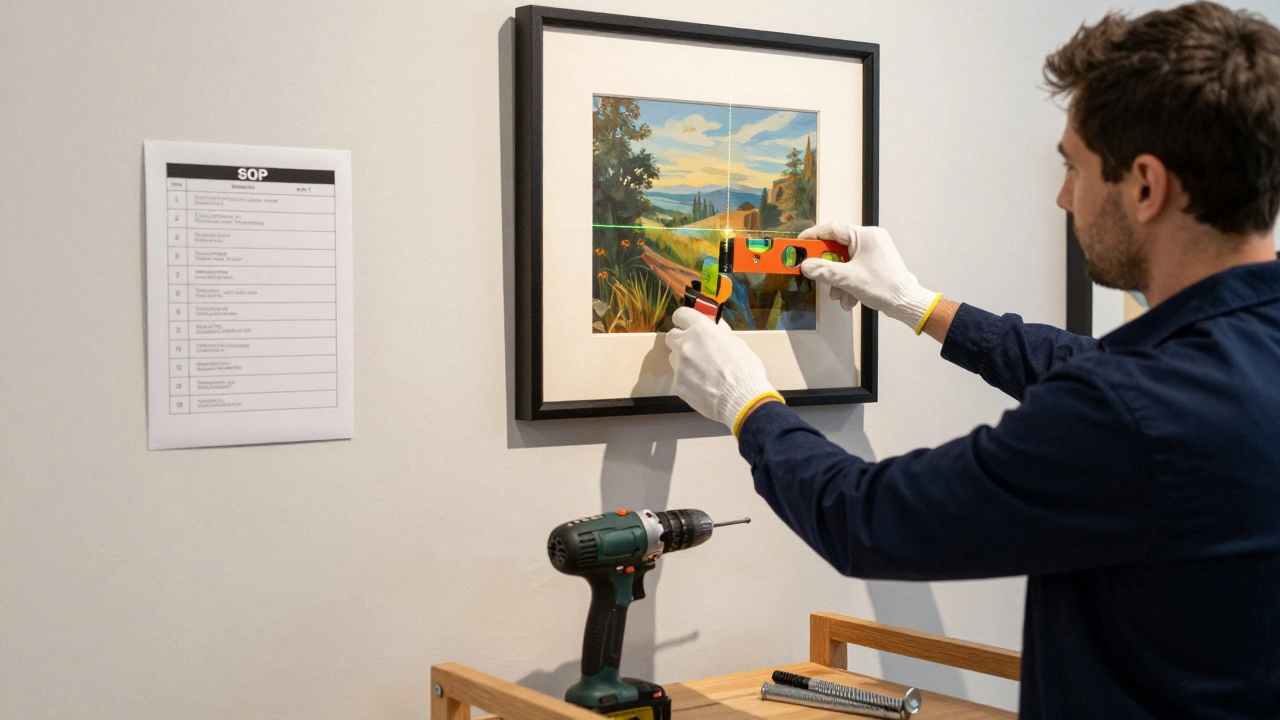
For example, here’s how a simple SOP for hanging artwork might look:
Goal: Safely hang artwork without damaging walls, frames, or the piece itself.
Steps:
- Verify the artwork’s weight and hanging hardware with the inventory log.
- Put on clean, cotton gloves before touching the frame.
- Use a laser level to mark placement-never guess by eye.
- Install two hanging points for pieces over 20 lbs.
- Take a photo of the installed piece and tag it in the digital catalog.
- Log the installation date and installer’s name in the wall logbook.
Tools: Cotton gloves, laser level, drill, wall anchors, camera, logbook
Who: Lead gallery assistant or curator
When: Before each exhibition opening
Notes: Never use nails. Never hang over HVAC vents. Always double-check weight limits.
Where to Start: Pick One Process
Don’t try to write all 10 SOPs at once. That’s how people quit before they begin.
Start with the most urgent or most broken process. For most small galleries, that’s receiving new artwork.
Here’s how to build it:
- Ask your staff: "What’s the messiest part of unboxing a new piece?"
- Watch someone do it-take notes. Don’t assume you know.
- Write down exactly what they do, step by step.
- Then, rewrite it to remove guesswork.
- Test it. Have a new person follow it without help. Did they get it right?
Once you’ve nailed one, move to the next. Use the same format. Keep it short. Use plain language. No jargon like "curatorial workflow" or "provenance documentation." Just say "check the invoice against the shipping manifest."

Who Writes the SOPs? (And Who Keeps Them Alive)
Don’t assign this to your director or an outside consultant. The people who do the work every day should write it. That’s the assistant who handles the crates. The front desk person who logs visitors. The volunteer who dusts the sculptures.
Here’s how to make it work:
- Hold a 30-minute workshop once a month. Bring snacks.
- Let each staff member pick one procedure they want to document.
- Use a shared Google Doc. Everyone can edit. No one owns it.
- Update it every time something changes. A new frame? A new alarm system? Add it.
Assign one person to be the "SOP Keeper"-not the boss, just someone who checks monthly if anything’s outdated. Pay them $50 a month extra. It’s worth it.
Keeping SOPs Alive
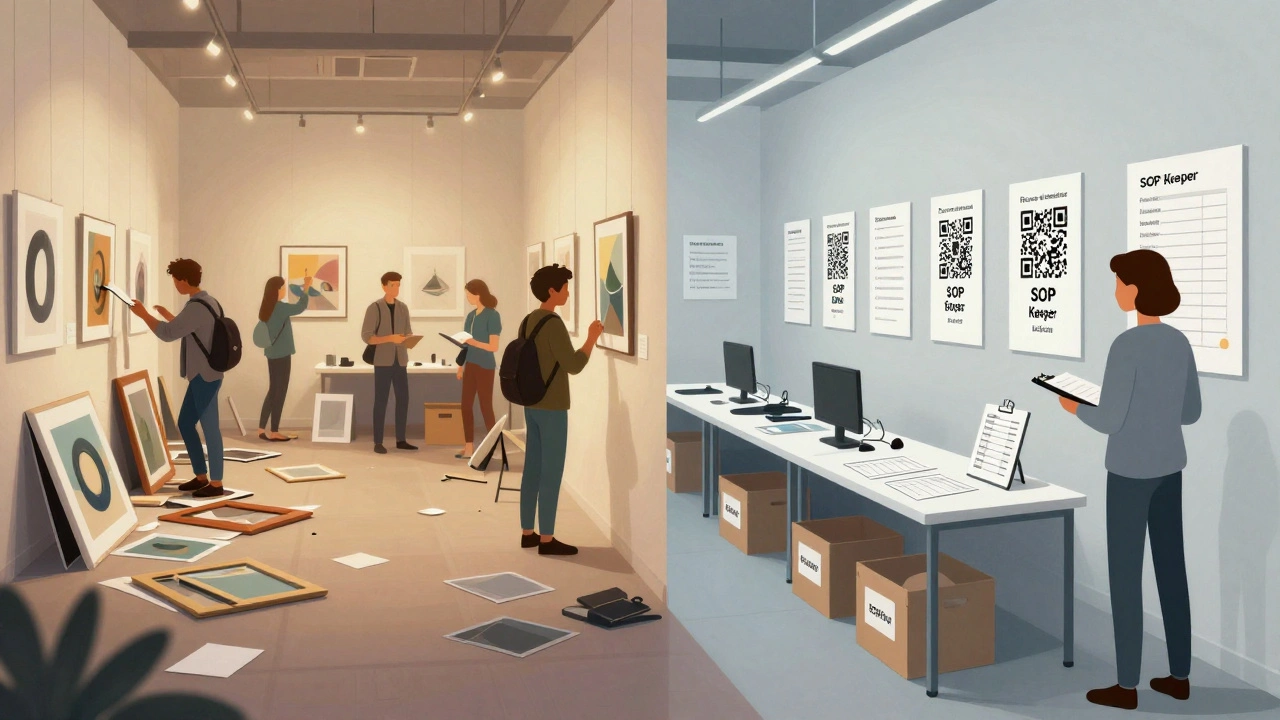
Here’s the hard truth: SOPs die if they’re locked in a drawer or buried in a PDF.
They need to be visible, easy to find, and used daily.
- Print the top 3 SOPs and laminate them. Hang them near the workstations.
- Use QR codes on wall signs that link to the full procedure.
- Include SOP checklists in daily shift handovers.
- Test new hires with a 5-minute SOP quiz on their first week.
- Make updating SOPs part of your annual review.
At the Portland Art Collective, they started with one SOP: how to respond to a water leak. Six months later, they had 14. No one got fired. No artwork was damaged. And the staff? They felt more in control.
Common Mistakes to Avoid
Even smart galleries mess this up. Here’s what not to do:
- Writing too much. One page per procedure. If it’s longer, split it.
- Using passive voice. "The artwork should be handled with gloves" → "Wear gloves before touching the artwork."
- Ignoring safety. Always include PPE requirements-even for "simple" tasks.
- Not testing it. If a new person can’t follow it without help, rewrite it.
- Locking it away. If it’s not easy to find, it’s useless.
Also, don’t wait for a disaster. Start now. Even if you only have three staff members. Even if you’re just opening next month. Your future self will thank you.
What Happens When You Don’t Have SOPs?
Last year, a small gallery in Eugene lost a $120,000 lithograph because the assistant didn’t know the humidity threshold for storage. The owner had no idea how to respond. No one had written it down.
Insurance didn’t cover it. The artist sued. The gallery closed six months later.
That didn’t have to happen.
Every gallery, big or small, has the same risks. The difference is preparation.
Do I need SOPs if I’m a small gallery with only two staff members?
Yes. Small galleries are actually more vulnerable. With fewer people, one mistake can shut you down. SOPs don’t need to be long. Even three simple procedures-handling art, opening/closing, and emergency contact-can save you from disaster. Start with one. Build from there.
How often should I update my SOPs?
Review them every six months. Update them immediately if anything changes: new security systems, new insurance rules, different suppliers, or after an incident. If your staff says, "We’ve been doing it this way for a year," that’s a red flag. The SOP is outdated.
Can I use templates from other galleries?
Templates are a great starting point-but don’t copy them. Every gallery has different spaces, collections, and risks. A procedure that works for a downtown loft space won’t fit a historic building with no climate control. Use templates to save time, then adapt them to your reality.
What if staff ignore the SOPs?
That usually means the SOPs are unclear, too long, or not relevant. Go back to the people who do the work. Ask why they’re skipping steps. Often, they’ve found a faster way-and you should too. SOPs aren’t about control. They’re about making work easier and safer for everyone.
Should I include photos or diagrams in my SOPs?
Yes, especially for handling, hanging, or equipment use. A picture of the correct way to attach a wire to a frame saves ten paragraphs of explanation. Use your phone to take quick photos during training. Add them to your Google Doc. Visuals cut confusion in half.
Next Steps
Here’s what to do this week:
- Choose one task that causes the most confusion or stress-receiving art, closing the gallery, logging sales.
- Ask two staff members to walk you through it. Write down every step.
- Turn it into a one-page SOP using the format above.
- Print it. Hang it where the work happens.
- Test it tomorrow with someone new.
You don’t need permission. You don’t need a budget. You just need to start. The first SOP you write will be messy. That’s fine. The tenth one? That’s when your gallery stops barely surviving-and starts running smoothly.