Gallery Lighting Equipment Guide: Spotlights, Track Lights & LEDs
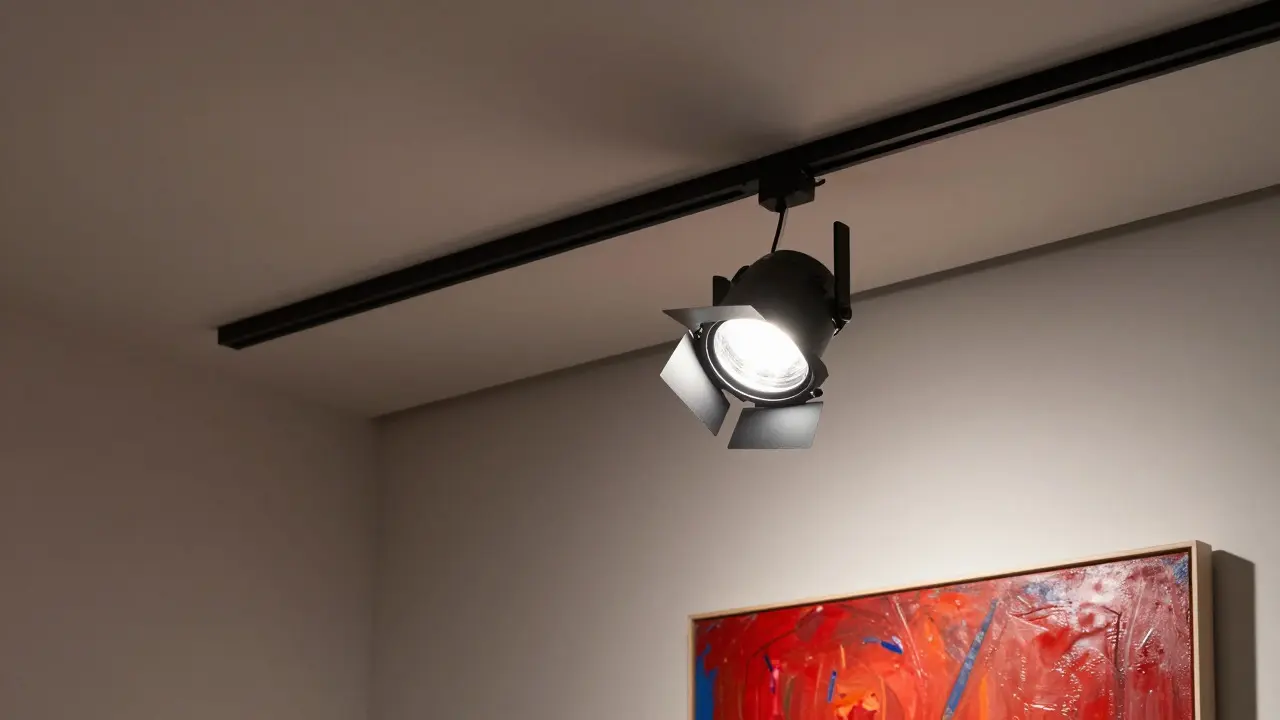
Walk into a dimly lit room where a single beam of light hits a canvas, and suddenly the painting looks alive. That’s not magic; it’s gallery lighting. But getting it right is harder than most people think. You need to balance visibility with preservation, aesthetics with practicality, and cost with longevity. If you’re setting up a home gallery, a small studio, or even a corporate lobby, understanding the difference between a cheap spotlight and a professional-grade track system can save you thousands in replacement costs and potential damage to your artwork.
Lighting isn't just about seeing the art; it's about controlling how the viewer perceives color, texture, and depth. A wrong bulb can wash out a masterpiece, while a well-placed fixture can make a modest print feel like a high-end installation. This guide breaks down the three main pillars of modern display lighting: dedicated spotlights, flexible track systems, and energy-efficient LED technology. We’ll look at the specs that actually matter, the common mistakes designers make, and how to choose the right setup for your specific space.
The Core Components of Professional Display Lighting
To understand what you’re buying, you first need to know what makes up a lighting rig. It’s not just a lamp; it’s an ecosystem of components working together. The primary source is the luminous element, usually an LED module or a halogen capsule. Surrounding this is the optical housing, which controls the beam angle. Then there’s the mounting hardware, which determines flexibility. Finally, there’s the driver or transformer, which regulates power. Ignoring any one of these parts leads to poor performance or short lifespan.
Most beginners focus only on the brightness, measured in lumens. However, in a gallery context, color rendering is far more critical. You want a light source that shows true colors without adding a yellow or blue tint. This is where the Color Rendering Index (CRI) comes in. For art display, you should aim for a CRI of 90 or higher. Anything below 85 will make reds look dull and skin tones appear waxy. Furthermore, the Kelvin temperature matters. Neutral white, around 3000K to 4000K, is the standard for most galleries because it mimics natural daylight without being too harsh. Too cool (above 5000K) feels clinical; too warm (below 2700K) makes everything look sepia.
Spotlights vs. Track Lights: Choosing Your Mounting Strategy
This is the biggest decision point for any designer. Do you go with individual, fixed spotlights, or do you install a continuous track system? The answer depends entirely on your layout and how often you change the exhibits.
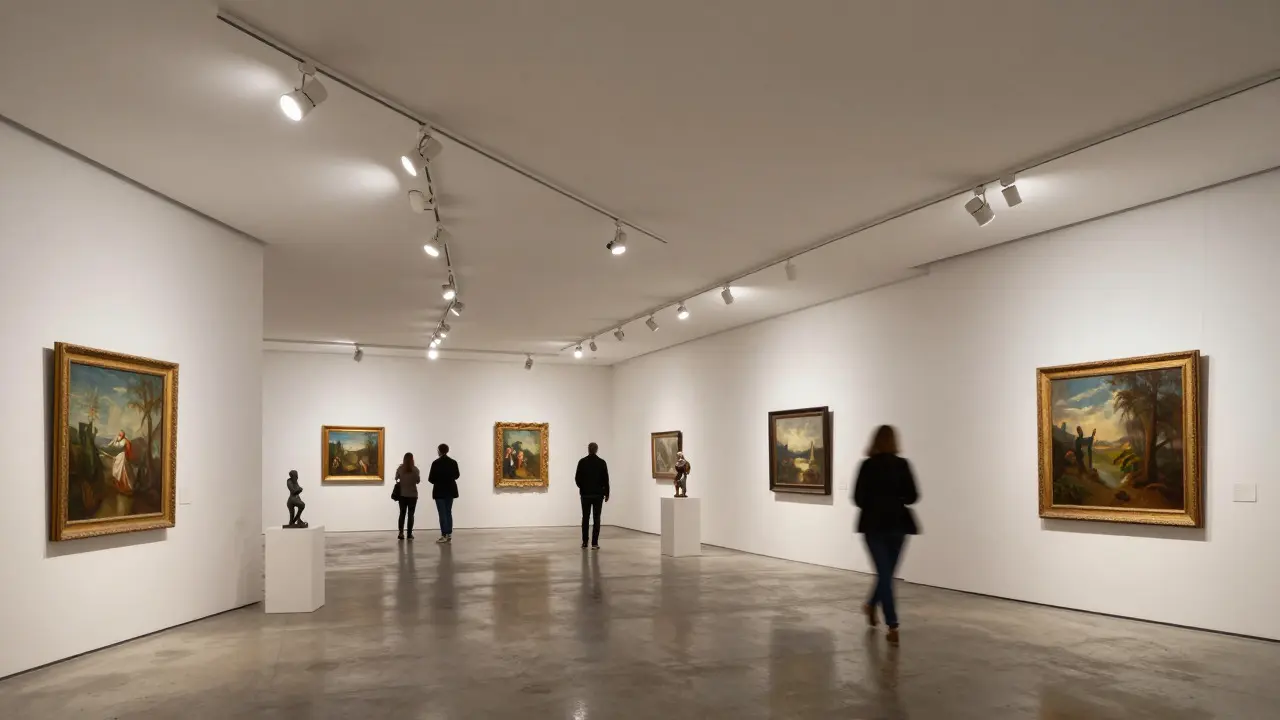
Track Lights are linear electrical conduits that allow multiple fixtures to be mounted and adjusted along a single path, offering maximum flexibility for dynamic displays.. They are the backbone of most commercial galleries and museums. Why? Because exhibits change. One month you have large paintings on the north wall; the next, you have small sculptures on pedestals. With track lighting, you can slide the heads, rotate them, and adjust the tilt without drilling new holes in the ceiling or walls. They also create a clean visual line that adds to the architectural aesthetic of the room.
On the other hand, dedicated spotlights (often called picture lights or wall-washers) are fixed units designed for a specific piece. These are ideal for permanent collections or high-value pieces that won’t move. Picture lights mount directly above the frame and cast a wide, soft beam that illuminates the entire surface evenly. Wall-washers, conversely, sit on the floor or ceiling and wash the wall with light, creating a gradient that highlights texture. If your space has static content, fixed spotlights provide a cleaner look and often better optical control than bulky track heads.
| Feature | Track Lighting | Fixed Spotlights/Picture Lights |
|---|---|---|
| Flexibility | High (adjustable position/angle) | Low (fixed position) |
| Best For | Changing exhibits, mixed media | Permanent collections, single focal points |
| Installation Complexity | Moderate (requires wiring to track) | Simple (hardwired or plug-in) |
| Aesthetic Impact | Visible linear element | Minimalist, invisible when off |
| Cost per Fixture | $50 - $150 | $30 - $80 |
Why LEDs Have Dominated the Gallery Space
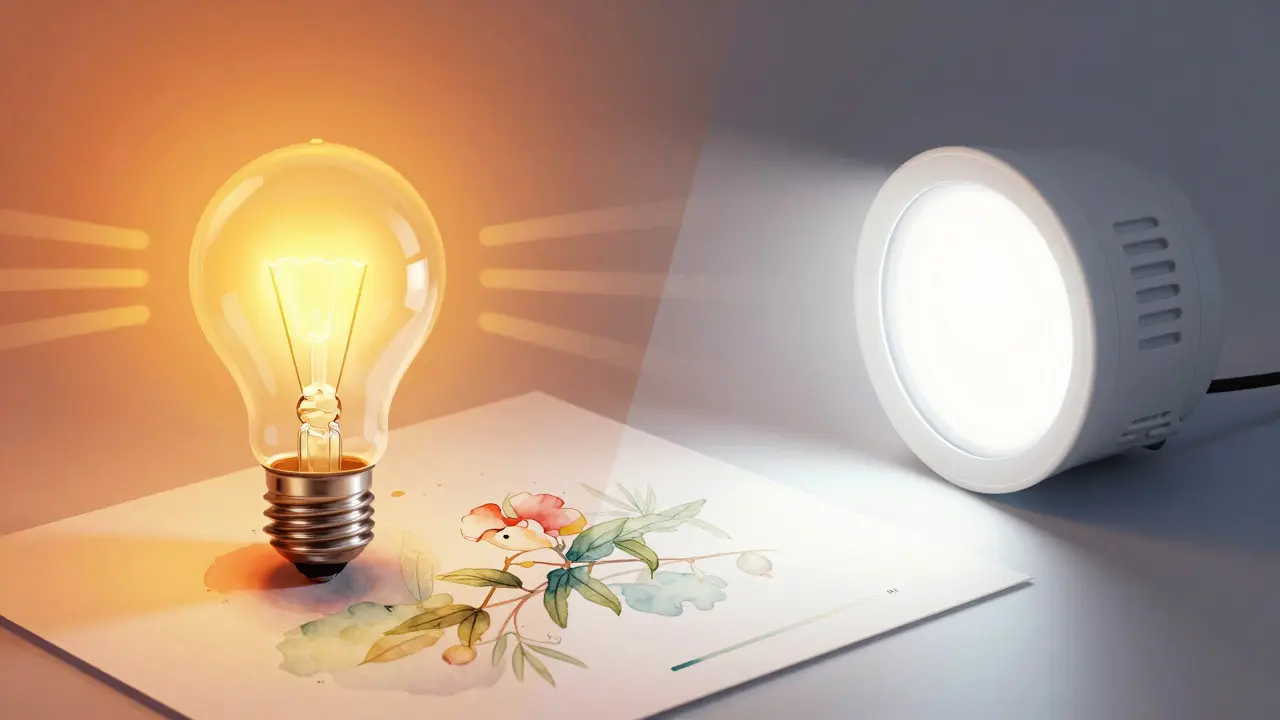
You might see some old-school designers still recommending halogens for their "perfect" light quality. While halogens did offer excellent color rendering, they had two fatal flaws: heat and energy consumption. Halogens run hot, which requires careful spacing from artworks to avoid damaging varnish or paper. They also consume significantly more power, leading to higher electricity bills over time.
Modern LED Spotlights are compact lighting devices using Light Emitting Diodes to produce focused beams with minimal heat generation, suitable for close-range illumination of delicate artworks. have solved these problems. Today’s high-quality LEDs match or exceed the color accuracy of halogens while running at a fraction of the wattage. A 10-watt LED spotlight can produce the same lumen output as a 50-watt halogen. More importantly, the heat signature is so low that you can place fixtures closer to the work without risk. This allows for tighter beam angles and more dramatic effects.
However, not all LEDs are created equal. Cheap LEDs often suffer from flicker, which is invisible to the naked eye but can cause headaches and affect video recording. When shopping, look for drivers that specify "flicker-free" or "high-frequency PWM." Also, pay attention to the beam angle. Narrow beams (15-24 degrees) are great for highlighting details in a sculpture or a small drawing. Wide beams (36-60 degrees) are better for washing a large mural or a group of smaller frames. Most professional track heads allow you to swap lenses to change the beam angle, giving you versatility without buying new fixtures.
Preservation Metrics: Lux Levels and UV Protection
If you’re displaying original works, especially watercolors, pastels, or photographs, you need to worry about light damage. Light causes chemical reactions that fade pigments over time. The key metric here is lux, which measures the intensity of light falling on the surface. As a rule of thumb, highly sensitive works should receive no more than 50 lux. Less sensitive works, like oil paintings or acrylics, can handle up to 150-200 lux.
How do you measure this? You don’t need expensive lab equipment. A simple handheld lux meter costs less than $50 and will tell you exactly how much light is hitting your canvas. Adjust your dimmers until you hit the target range. Dimming is another huge advantage of LED systems. Being able to lower the intensity during closing hours or for particularly sensitive pieces is a feature you’ll use constantly.
What about UV rays? Old fluorescent tubes were notorious for emitting harmful ultraviolet light. Modern LEDs emit virtually zero UV naturally. However, if you are using any hybrid systems or older fixtures, ensure they have UV-filtering glass or plastic covers. It’s a cheap insurance policy for your collection. Always check the spec sheet for "UV index" or "UV emission" levels. Lower is better, ideally under 10 microwatts per lumen.
Practical Setup Tips for Different Spaces
Let’s talk real-world application. How does this look in a home versus a commercial space?
In a home gallery, you likely have irregular wall heights and furniture that blocks direct lines of sight. Here, picture lights are often the best choice. They mount directly above the frame, ensuring the light hits the art regardless of what’s underneath. If you have a hallway with several small frames, a narrow track system can provide consistent illumination without cluttering the walls. Keep the tracks at least 6 inches away from the top of the frames to avoid glare. Glare is the enemy of good viewing. If you see reflections of the light source in the glass or varnish, adjust the angle or add anti-glare filters to the lenses.
In a commercial or office setting, consistency is key. Visitors walk through quickly, so the lighting needs to be uniform. Use track lights with medium-wide beams to cover larger areas evenly. Avoid sharp contrasts between lit and unlit zones, as this forces the viewer’s eyes to adjust constantly, causing fatigue. Group your fixtures logically. If you have a row of four portraits, use four separate heads rather than one wide beam, which would create uneven shadows between the frames.
- Check for Shadows: Stand back 10 feet from the wall. If you see dark corners in the frame, adjust the beam angle wider or move the fixture closer to the wall.
- Test Color Accuracy: Print a color test chart and hang it temporarily. See if the colors look true under your new lighting. If reds look orange, your Kelvin temperature might be too warm.
- Consider Circulation Patterns: Place brighter accents where people stop and look, and softer ambient light in walkways.
Budgeting and Long-Term Maintenance
Buying the cheapest fixtures is a false economy. A $20 spotlight may work for a year, but then the driver fails, or the color shifts. Professional-grade fixtures from reputable brands typically last 50,000 hours or more. At 5 hours of use per day, that’s nearly 27 years of service. Factor in the cost of labor for replacements. If you hire an electrician, every trip-out fee eats into your savings. Investing in durable, high-CRI fixtures upfront saves money in the long run.
Maintenance is mostly about dust. Dust on lenses reduces light output by up to 20%. Wipe your fixtures down once a quarter with a microfiber cloth. Check the connections annually to ensure no loose wires are causing flickering. If you use smart lighting systems, keep the firmware updated to fix bugs and improve energy efficiency. Many modern systems allow you to schedule lighting scenes, turning off unused areas automatically to save power.
Frequently Asked Questions
What is the best beam angle for painting?
For most paintings, a beam angle between 30 and 40 degrees works well. This provides enough coverage to illuminate the entire canvas without spilling excessive light onto the surrounding wall. For very large murals, you may need wider angles or multiple fixtures.
Can I use regular household LED bulbs in gallery fixtures?
Generally, no. Household bulbs are designed for general room lighting and often have lower CRI ratings (80-85) and inconsistent beam patterns. Gallery fixtures require specialized optics to control glare and spread. Using a standard bulb in a track head may result in hot spots or uneven illumination.
How far should track lights be from the artwork?
There is no single rule, but a common guideline is to place the fixture 6 to 12 inches from the top edge of the frame. The exact distance depends on the beam angle. Narrower beams require the fixture to be closer to the wall to avoid shadows. Wider beams can be further away. Always test and adjust based on the actual effect.
Do LEDs damage photos over time?
LEDs are much safer for photos than incandescents or fluorescents because they emit very little heat and UV radiation. However, light exposure still accumulates. To preserve photos, keep lux levels low (under 50), limit daily display hours, and rotate exhibits seasonally.
Is dimming necessary for gallery lighting?
Dimming is highly recommended. It allows you to fine-tune the intensity for different types of artwork, reduce glare during bright daylight hours, and create mood changes for events. Most professional LED drivers support smooth dimming, which is a valuable feature for versatile spaces.