Formalist Art Criticism: How to Analyze Form and Composition

Imagine standing in front of a canvas. You don't care about the artist's biography, the historical context, or the political message they might be trying to send. You only care about the paint itself-the way the red clashes with the blue, how the thick brushstrokes create texture, and whether the shapes balance each other out. That is the heart of formalist art criticism, which focuses exclusively on the visual elements and principles of design within a work of art.
This approach strips away the noise. It asks you to look at the object as it exists in space and time, independent of external meanings. For decades, this was the dominant way critics and curators evaluated modern art. But does it still hold up? Can we truly judge a painting by its shape and color alone, ignoring everything else?
The Core Philosophy: "Art for Art's Sake"
To understand formalism, you have to go back to the idea that art should be judged by its own internal rules. This concept is often linked to the phrase "art for art's sake." The core argument is simple: the value of a piece lies in its form, not its content or function.
Clement Greenberg, the most influential American critic of the mid-20th century, championed this view. He argued that every art medium has its own unique essence. For painting, that essence is flatness. A painting is a flat surface covered with pigment. Therefore, good painting acknowledges this flatness rather than trying to hide it with illusionistic depth.
Greenberg’s theories helped define Abstract Expressionism. He praised artists like Jackson Pollock because their work focused on the physical act of painting-the drip, the splash, the gesture-rather than representing recognizable objects. In this view, the more "pure" the art became, the better it was.
- Flatness: Acknowledging the two-dimensional nature of the canvas.
- Medium Specificity: Each art form (painting, sculpture) should explore what makes it unique.
- Aesthetic Autonomy: Art exists independently from society, politics, or morality.
This philosophy was revolutionary at the time. It shifted the focus from "what does this picture show?" to "how does this picture work?"
Key Elements Formalists Look For
When you practice formalist analysis, you are looking at specific visual components. These are the building blocks of any image. Here is what you need to pay attention to:
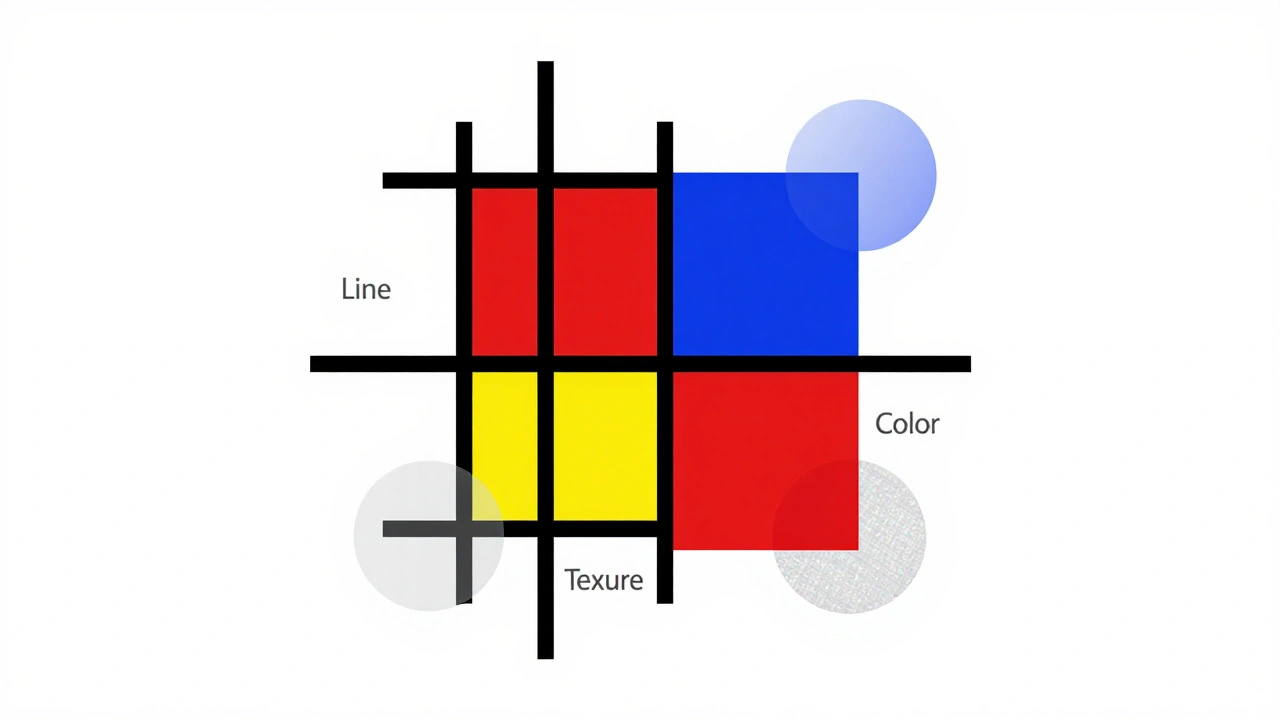
- Line: Is it sharp and geometric, or soft and organic? Does it guide your eye through the composition?
- Color: Are the colors harmonious or contrasting? Do they create warmth or coolness? Think about how Johannes Itten taught color theory at the Bauhaus school, emphasizing the emotional impact of color relationships.
- Shape and Form: Are the shapes abstract or representational? How do they interact with negative space?
- Texture: Is the surface smooth, rough, impasto, or glossy? Texture adds a tactile quality to the visual experience.
- Space: How does the artist use depth? Even in abstract art, there is a sense of spatial arrangement.
- Composition: How are all these elements arranged? Is the balance symmetrical or asymmetrical? Is there a focal point?
For example, when looking at a Piet Mondrian painting, a formalist would analyze the precise grid of black lines and the primary blocks of red, yellow, and blue. They wouldn't ask what the painting means symbolically; they would evaluate how the tension between the vertical and horizontal lines creates a dynamic equilibrium.
Famous Examples of Formalist Analysis
Let’s look at how this method works in practice. Consider the work of Mark Rothko. His large-scale canvases feature soft, rectangular fields of color hovering against dark backgrounds. A formalist critic would praise the subtle gradations of hue and the way the edges blur, creating a sense of infinite space without using perspective tricks. The power comes from the interaction of light and pigment, not from any narrative story.
Another classic example is Frank Stella's early geometric abstractions. Stella famously said, "What you see is what you see." This statement encapsulates the formalist stance. The painting is an object. It is a shaped canvas with paint on it. There is no hidden meaning behind the curtain. The complexity lies entirely in the arrangement of forms.
| Aspect | Formalist Criticism | Contextual/Social Criticism |
|---|---|---|
| Focus | Visual elements (line, color, shape) | Historical, social, political context |
| Goal | Aesthetic purity and autonomy | Understanding meaning and impact |
| Key Question | How does it work visually? | Why was it made? What does it signify? |
| Best For | Abstract art, decorative arts | Realism, propaganda, conceptual art |
The Limitations of Formalism
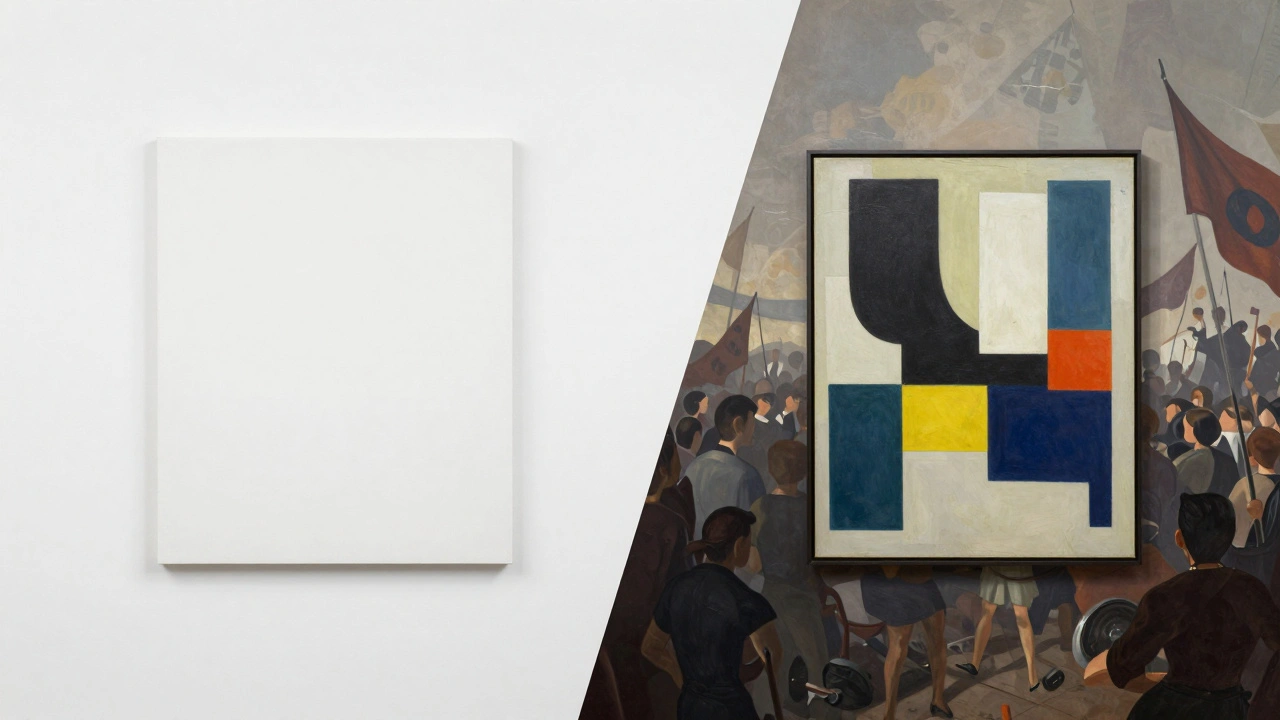
While formalism gave us powerful tools for analyzing abstract art, it has significant blind spots. By ignoring context, you risk missing the entire point of many artworks. For instance, if you analyze a protest poster using only formalist criteria, you might praise its bold typography and high-contrast colors but completely miss the urgent political message it carries.
Critics like T.J. Clark argued that art cannot be separated from the society that produces it. They pointed out that even "pure" abstraction is influenced by cultural norms, gender roles, and economic conditions. Ignoring these factors leads to an incomplete understanding.
Furthermore, formalism tends to favor certain types of art over others. It works well for modernist abstraction but struggles with figurative art, photography, or performance art where the body and action are central. If you apply strict formalist standards to a documentary photograph, you might dismiss it for lacking "compositional perfection" while overlooking its profound human truth.
Applying Formalism Today
So, is formalism dead? Not entirely. While few critics today rely on it exclusively, it remains a vital part of visual literacy. Learning to see form helps you appreciate craftsmanship and design intent. Whether you are looking at a Renaissance fresco, a contemporary installation, or a graphic design layout, understanding composition gives you a deeper appreciation of how the creator guided your eye.
In the digital age, formalism finds new life in user interface (UI) design. Designers constantly make decisions about hierarchy, spacing, and color contrast-not to tell a story, but to ensure usability and aesthetic clarity. The principles Greenberg discussed for painting are now applied to smartphone screens.
To get the most out of formalist analysis, try this exercise next time you visit a gallery:
- Stand close enough to see the brushstrokes or pixels.
- Ignore the title and the placard description initially.
- Ask yourself: Where does my eye go first? Why?
- Identify the dominant line, color, or shape.
- Consider how the negative space interacts with the positive forms.
This practice trains your eye to notice details that casual viewers often miss. It doesn't replace contextual knowledge, but it complements it. When you combine formal analysis with historical insight, you gain a richer, more nuanced perspective.
Related Concepts in Art Theory
Formalism didn't exist in a vacuum. It developed alongside other critical movements. Understanding these connections helps clarify where formalism fits in the broader landscape of art history.
Modernism is the broader movement that formalism supported. Modernists believed in progress, innovation, and breaking from tradition. Formalism provided the theoretical justification for why abstract art was "better" than realistic art-it was more honest to the medium.
In contrast, Postmodernism rejected formalist purity. Postmodern critics embraced irony, appropriation, and mixed media. They argued that meaning is constructed by the viewer and the culture, not inherent in the object itself. This shift moved criticism away from aesthetics toward interpretation and ideology.
Even Gestalt Psychology influences formalist thinking. Gestalt principles explain how humans perceive whole patterns rather than individual parts. For example, we tend to group similar shapes together or fill in missing lines to create complete forms. Formalists use these psychological tendencies to explain why certain compositions feel balanced or chaotic.
Who is the father of formalist art criticism?
Clement Greenberg is widely considered the leading figure of formalist art criticism in the 20th century. He promoted the idea that art should be judged by its adherence to the specific qualities of its medium, particularly flatness in painting.
What is the difference between formalism and iconography?
Formalism focuses on visual elements like color, line, and composition, ignoring symbolic meaning. Iconography, on the other hand, studies the symbols, themes, and subjects within a work to uncover its cultural or religious significance.
Is formalism still relevant in contemporary art?
Yes, but rarely as the sole method of analysis. Contemporary critics often combine formalist observations with contextual, social, and political frameworks. However, formalist skills remain essential for understanding design, architecture, and visual communication.
Can you use formalism to analyze photography?
Absolutely. Formalist analysis in photography looks at framing, lighting, contrast, depth of field, and composition. It evaluates how these technical choices affect the viewer's perception, regardless of the subject matter.
What are the main criticisms of formalism?
The main critique is that formalism isolates art from reality. Critics argue that ignoring historical context, artist intent, and social impact leads to a shallow understanding. It also tends to privilege abstract art over narrative or representational works.