Exclusive Licensing Deals: How to Negotiate and Earn Premium Rates

Imagine sitting down with a major brand that wants your design, technology, or content. They offer you a deal, but there’s a catch: they want exclusivity. You hand over the keys to your creation for a specific market or region, and in return, they promise higher payments. This is the core of exclusive licensing, which is a contractual agreement where a licensor grants exclusive rights to use their intellectual property to a single licensee within a defined scope. While non-exclusive deals are easier to sell, they rarely pay well. Exclusive deals require more work, stricter terms, and careful negotiation, but they are the only way to consistently earn premium royalty rates and maximize the value of your assets.
The difference between an exclusive license and a standard one isn't just legal jargon; it's about leverage. When you grant exclusivity, you are giving up potential revenue from other partners. The licensee knows this. They also know that by paying you a premium, they secure a competitive advantage that no one else can replicate. If you don’t understand how to structure these deals, you might leave thousands-or even millions-on the table. Let’s break down exactly how to position yourself, negotiate the terms, and ensure you get paid what your work is truly worth.
Understanding the Value of Exclusivity
To command premium rates, you first need to understand why a company would pay them. In business, exclusivity creates scarcity. If a fashion brand licenses your unique pattern exclusively for their summer collection, competitors cannot use that same visual identity. This gives them a distinct market position. That distinctiveness has monetary value.
Consider the case of a software developer who creates a specialized algorithm for data analysis. If they license it non-exclusively to ten different firms, each firm pays a lower fee because the technology isn't rare. However, if they grant an exclusive license to one enterprise giant for the healthcare sector, that company gains a monopoly on that specific application. They will pay significantly more for that monopoly power. Your job as the licensor is to quantify that monopoly power and price it accordingly.
- Market Protection: The licensee pays to prevent competitors from using similar IP.
- Brand Association: Exclusive ties often mean the licensee invests heavily in marketing your IP as part of their brand.
- Revenue Predictability: Exclusive deals often come with guaranteed minimums, reducing your risk.
When you sit at the negotiating table, remind the other party that they aren't just buying permission to use your work; they are buying the absence of competition. Frame your pricing around the revenue they expect to generate from that exclusivity, not just the cost of creating the asset.
Structuring the Deal for Maximum Revenue
A common mistake creators make is accepting a flat upfront fee for an exclusive license. This is a trap. An upfront fee covers your immediate costs, but it doesn’t capture the long-term value of your IP. To earn true premium rates, your compensation structure must be dynamic.
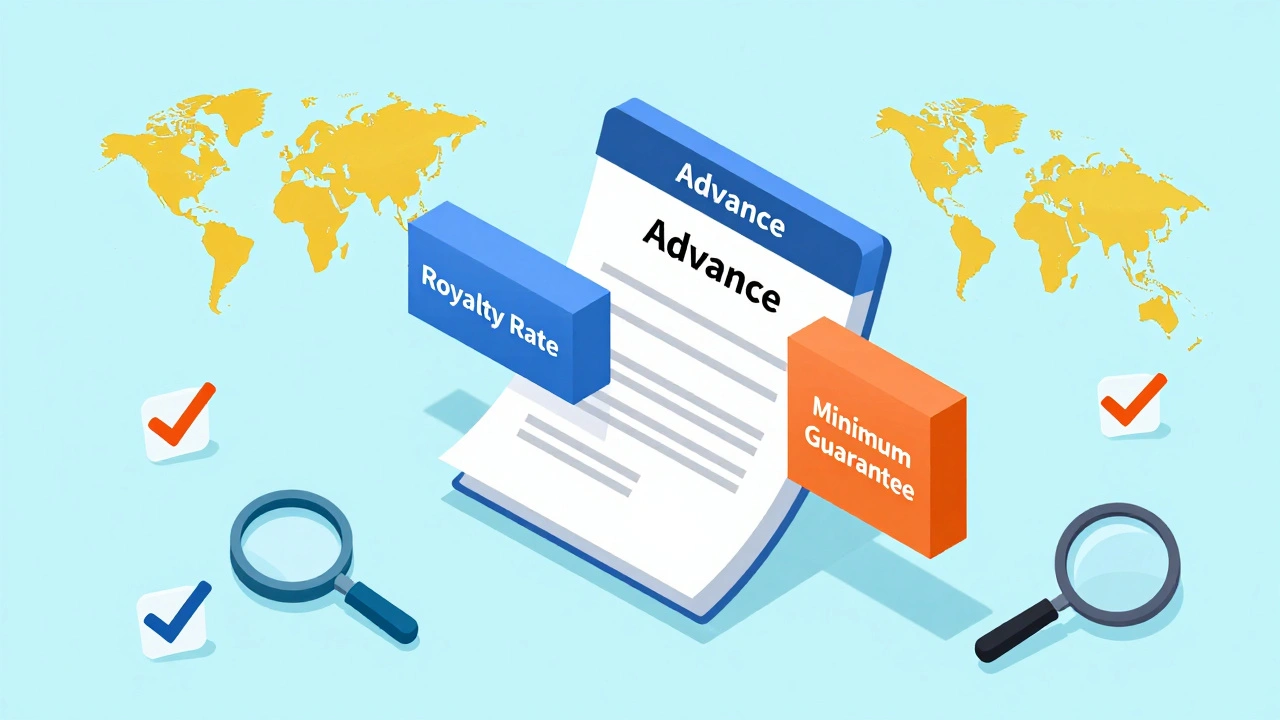
The most effective model combines three elements: an advance, a royalty rate, and a minimum guarantee. The advance is recoupable against future royalties. The royalty rate should be higher than standard industry benchmarks because of the exclusivity. For example, while a standard book royalty might be 10%, an exclusive digital rights deal could command 15-20%. The minimum guarantee ensures that even if sales are low, you still receive a baseline payment that reflects the exclusive nature of the partnership.
| Component | Non-Exclusive Deal | Exclusive Deal (Premium) |
|---|---|---|
| Upfront Fee | Low or None | High Advance (Recoupable) |
| Royalty Rate | Standard Market Rate (e.g., 5-10%) | Premium Rate (e.g., 15-25%) |
| Minimum Guarantee | Rarely Included | Mandatory Annual Minimums |
| Audit Rights | Limited | Comprehensive Access |
Notice the audit rights row. With exclusive deals, you have less visibility into how your IP is being used since there’s only one partner. Therefore, you must insist on robust audit clauses that allow you to verify sales figures annually. Without this, you cannot confirm if you’re actually earning those premium rates.

Negotiating Scope and Territory
Exclusivity is never absolute. It is always bounded by scope and territory. A critical error is signing a deal that grants global exclusivity for all uses when the licensee only intends to operate in one country or one product category. This kills your ability to license to others elsewhere.
You must define the territory precisely. Is it North America? The European Union? Worldwide? Generally, you should grant exclusivity only in markets where the licensee has the distribution capability to succeed. If they lack presence in Asia, do not give them exclusive rights there. Keep those rights reserved so you can license to a local partner later.
Similarly, define the field of use. If you are a musician, you might grant exclusive rights for commercial advertising but retain rights for personal merchandise or streaming platforms. By narrowing the scope of exclusivity, you maintain leverage. The narrower the scope, the easier it is to justify a high rate for that specific niche, while keeping broader opportunities open for future deals.
Protecting Your Intellectual Property
When you enter an exclusive licensing deal, you are handing over control. The licensee becomes the face of your IP in the marketplace. If they mishandle it, damage the brand, or fail to meet quality standards, your reputation suffers. This is why protective clauses are non-negotiable.
Include a quality control clause that requires the licensee to submit prototypes or marketing materials for your approval before launch. This ensures your creative vision remains intact. Additionally, include a performance clause with clear milestones. If the licensee fails to launch the product within six months or sells fewer than 1,000 units in the first year, the exclusivity should revert to you. This "clawback" provision prevents companies from sitting on your IP without generating revenue, effectively locking you out of the market.
Also, consider trademark implications. If the licensee uses your name alongside theirs, ensure the contract specifies how the trademark is displayed. Misuse of trademarks can dilute your brand equity, making it harder to command premium rates in future negotiations.
Common Pitfalls to Avoid
Even experienced licensors fall into traps. One of the biggest is emotional attachment. You love your creation, so you trust the big company to treat it well. But business is business. Always assume the relationship could end poorly and structure the exit accordingly.
Another pitfall is vague definitions of "net profits." Some contracts base royalties on net profits rather than gross revenue. Net profits can be manipulated through accounting tricks, leaving you with pennies. Insist on royalties based on gross wholesale revenue or net sales, clearly defined as the amount invoiced to customers minus returns and taxes. Never accept a profit-share model unless you have full access to their books.
Finally, beware of perpetual licenses. An exclusive license should have a fixed term, such as two to five years. At the end of the term, you renegotiate. If the IP has become more valuable, you can demand higher rates. Perpetual deals lock you into today’s prices forever, ignoring inflation and market growth.
Real-World Application: Case Studies
Let’s look at how this works in practice. Consider a graphic designer who creates a series of illustrations for children’s books. Instead of selling the images outright, she grants an exclusive license to a toy manufacturer for plush toys in the US market for three years. She charges a $50,000 advance plus a 12% royalty on net sales. Because the toy company had exclusive rights, they marketed the line aggressively, resulting in $500,000 in sales. Her earnings totaled $60,000 in royalties plus the advance, far exceeding what she would have earned from a one-time sale.
In contrast, a photographer granted worldwide exclusive rights to a stock photo agency for ten years for a flat fee. He couldn’t license those photos to anyone else, including his own clients. The agency sold them cheaply to multiple users, and he received no additional income. This highlights the importance of limiting duration and geography.
These examples show that the structure matters more than the initial enthusiasm. Careful planning leads to sustainable income streams.
What is the difference between exclusive and non-exclusive licensing?
In exclusive licensing, you grant rights to only one licensee within a defined scope, preventing you from licensing to others. Non-exclusive licensing allows you to grant rights to multiple parties simultaneously. Exclusive deals typically command higher fees due to the scarcity and competitive advantage they provide the licensee.
How much more should I charge for an exclusive license?
There is no fixed multiplier, but exclusive licenses generally command 20-50% higher royalty rates than non-exclusive ones. You should also expect a significant upfront advance and annual minimum guarantees. The exact premium depends on the market size, the strength of your IP, and the licensee’s projected revenue.
Can I revoke an exclusive license?
Yes, if you include performance clauses and clawback provisions in your contract. These clauses allow you to terminate exclusivity if the licensee fails to meet sales targets, launches products late, or breaches quality standards. Always specify these conditions clearly before signing.
Should I grant worldwide exclusivity?
Only if the licensee has the resources to distribute globally. Otherwise, limit exclusivity to specific territories where they can actively market and sell. Retaining rights in other regions allows you to license to local partners, maximizing your total revenue.
What happens if the licensee goes bankrupt?
If the licensee goes bankrupt, your license may become part of their estate. To protect yourself, include a termination clause that automatically ends the license upon bankruptcy. Ensure you retain ownership of the IP and any marketing materials created during the partnership.